The son of artist David Wright and his wife Esme M. (née Little), born in Abersoch, North Wales, educated at Barrow Hills Prep School and St George’s College, Weybridge. Patrick Wright began his career as a comic strip artist in the early 1970s drawing the adventures of Emma Faren for Princess Tina, working through Bardon Art. He continued working in comics throughout the 1970s, including a year’s work on “Modesty Blaise” for the Evening Standard.
Besides Modesty, he is probably best known for his war strips, which include issues of Commando, the Mike Nelson series in Battle Picture Weekly, beginning with 'Day of the Eagle' in 1975 and 'Hitler Lives' in The Crunch in 1979.
In 1981 he switched to humorous cartooning, publishing his first book, Walkies (Heinemann) in 1982. His other books are A Tale of Two Mothers-in-Law (Heinemann, 1983), Health and Efficiency (Heinemann, 1984), Affairs of the Heart (Heinemann, 1985), Off the Rails (Newton Abbot, David & Charles, 1985), Off the Road (Newton Abbot, David & Charles, 1988), Worthless Pursuits (Penguin, 1992), 101 Uses for a John Major (with Peter Richardson, Deutsch, 1993), 101 Further Uses for a John Major (Deutsch, 1994), Not Inconsiderable: Being the Life and Times of John Major (Deutsch, 1996). He has also worked extensively in all aspects of advertising, has illustrated books and has contributed cartoons to Private Eye.
Examples of Patrick Wright's artwork can be found at the Illustration Art Gallery.
Wednesday, April 24, 2013
Wednesday, April 17, 2013
John Worsley
John Worsley was a versatile artist who turned his talent to an
extraordinary range of work. Even in his late seventies, he could be
found busy in his studio working on a marine painting, a sculpture or
glass engraving. He was a gracious guest of honour at dinners organised
by fans of his famous comic strip, "The Adventures of PC 49", and
impressed a new generation with his collection of wartime sketches, John Worsley’s War.
Although his paintings and portraits (including those of Montgomery and
Admiral Sir John Cunningham) can be seen in the Imperial War Museum and
National Maritime Museum, not all of his work was so public, as he
worked tirelessly as a police sketch artist, his facility for capturing a
likeness responsible for many arrests.
His ability to accurately report through his work was recognised early by the Admiralty who ordered Midshipman Worsley into the thick of things as the youngest official War Artist in the Mediterranean. Worsley had already survived the sinking of H.M.S. Laurentic by a German U-Boat in November 1940, and now found himself taking part in the landings at Sicily, Reggio and Salermo. In 1943 he was amongst the rescue party sent to establish a base on Lussin Piccola in the North Adriatic, only to find it overrun by Germans.
Worsley was taken to Germany where he was interrogated, spending much of the next two months in solitary confinement before being sent to the POW camp Marlag ‘O’, near Bremen. Amongst the other prisoners was journalist Guy Morgan who had been badly wounded and was to be repatriated, smuggling out a number of Worsley’s drawings in the plaster cast on his arm.
A more daring escapade was the escape plans of Lieutenant Mewes which required the assistance of a stand-in. Out of wire and papier mache, Worsley created a dummy, dubbed ‘Albert, R.N.’, who was held between two soldiers during roll call, fooling the guards into thinking they had a full compliment of prisoners whilst Mewes made his way to the coast. For four days, Albert, with his ping-pong ball eyes and no hands (his sleeves were stuffed into his jacket pockets), fooled the guards. Unfortunately, Mewes was refused passage on the northern coast of Germany, and was recaptured. ‘Albert’ was finally rumbled when a second escape attempt two months later was foiled quickly and the escapee caught just after roll call, the guards realising they now had one too many prisoners.
Back in England, Guy Morgan immortalised 'Albert R.N.' in a play which was filmed in 1953. The movie starred Jack Warner and Anthony Steel, the latter portraying Geoffrey Ainsworth, a fictional version of Worsley. Worsley recreated Albert for the film, the dummy now at the Naval Museum in Portsmouth.
Born in Liverpool on 16 February 1919, Worsley was the son of a Naval officer who, demobbed six months later, moved his family back to the family coffee farm in Kabuka, 40 miles north of Nairobi in Kenya. It was here amidst the spectacular scenery and at an altitude of 6000 feet that John Worsley grew up, shooting and messing around in the family Model T Ford when he wasn’t attending school.
This idyllic life came to a crashing end in 1928 when the recession caused the price of coffee beans to collapse, and John was sent to St. Winifred’s boarding school, his fees subsidised by a grant from the Royal Navy Trust. He won a scholarship to Brighton College, and entered Goldsmiths’ College School of Art where he studied for three years, subsisting on a £300 legacy which he eked out at £2 a week, still finding the money—£4—to purchase a second hand Fiat in his third year. This he used, after leaving College, to travel along the South Coast, making sketches which he would sell to magazines.
Worsley’s experiences in the Royal Navy, which began with a three week crash course in seamanship in 1939 did not end with his repatriation. As allied troops advanced in early 1945, Worsley and other POWs were forced to march the 80 miles to Lubeck, arriving a few days before the war ended. When Worsley returned to the UK it was to a small studio in Baron’s Court where he was asked by the Admiralty to paint portraits of many high ranking officers.
Worsley found work in illustration through an agency and found himself working on the Eagle comic soon after its launch painting a full-page advertising strip for Walls Ice Cream starring Tommy Walls, a young lad whose heroics were always accomplished by making the Lucky Walls Sign, and whose reward was, inevitably, lashings of ice cream.
It was as the artist for "The Adventures of PC 49" that Worsley really reached an audience; from his first episode in August 1951, he would eventually draw the tales of Archibald Berkeley-Willoughby until his final appearance in March 1957. 290 episodes appeared in Eagle comic alone, with further tales appearing in Eagle Annual and various spin-off books. Worsley’s was, to most fans, the definitive portrait, and Worsley himself commented "You cannot portray a character three thousand times without getting to know him pretty well." Three quarters of a million schoolboys relished every brushstroke each week. Worsley also worked for the Eagle’s companion paper, Girl, drawing "The Story of Miriam" (1951-52) and "Belle of the Ballet" (1952-54), and for many years was an illustrator for the educational nursery paper, Treasure, notably drawing the adventures of "Wee Willie Winkie" (1963-67).
In later years, Worsley was commissioned by Esso to produce a series of paintings of life on oilfields in Iraq and America. Never standing still, Worsley also embraced the new medium of independent television, and produced hundreds of colour illustrations for readings of famous children’s stories; many of them were later used as illustrations for large format hardcover books published by Purnell and Deans. An article about his work by one of his enthusiasts was entitled “The Complete Artist” and nobody earned that title more than John Worsley.
Worsley died on 3 October 2000, aged 81.
Examples of Worsley's work can be found at the Illustration Art Gallery.
His ability to accurately report through his work was recognised early by the Admiralty who ordered Midshipman Worsley into the thick of things as the youngest official War Artist in the Mediterranean. Worsley had already survived the sinking of H.M.S. Laurentic by a German U-Boat in November 1940, and now found himself taking part in the landings at Sicily, Reggio and Salermo. In 1943 he was amongst the rescue party sent to establish a base on Lussin Piccola in the North Adriatic, only to find it overrun by Germans.
Worsley was taken to Germany where he was interrogated, spending much of the next two months in solitary confinement before being sent to the POW camp Marlag ‘O’, near Bremen. Amongst the other prisoners was journalist Guy Morgan who had been badly wounded and was to be repatriated, smuggling out a number of Worsley’s drawings in the plaster cast on his arm.
A more daring escapade was the escape plans of Lieutenant Mewes which required the assistance of a stand-in. Out of wire and papier mache, Worsley created a dummy, dubbed ‘Albert, R.N.’, who was held between two soldiers during roll call, fooling the guards into thinking they had a full compliment of prisoners whilst Mewes made his way to the coast. For four days, Albert, with his ping-pong ball eyes and no hands (his sleeves were stuffed into his jacket pockets), fooled the guards. Unfortunately, Mewes was refused passage on the northern coast of Germany, and was recaptured. ‘Albert’ was finally rumbled when a second escape attempt two months later was foiled quickly and the escapee caught just after roll call, the guards realising they now had one too many prisoners.
Back in England, Guy Morgan immortalised 'Albert R.N.' in a play which was filmed in 1953. The movie starred Jack Warner and Anthony Steel, the latter portraying Geoffrey Ainsworth, a fictional version of Worsley. Worsley recreated Albert for the film, the dummy now at the Naval Museum in Portsmouth.
Born in Liverpool on 16 February 1919, Worsley was the son of a Naval officer who, demobbed six months later, moved his family back to the family coffee farm in Kabuka, 40 miles north of Nairobi in Kenya. It was here amidst the spectacular scenery and at an altitude of 6000 feet that John Worsley grew up, shooting and messing around in the family Model T Ford when he wasn’t attending school.
This idyllic life came to a crashing end in 1928 when the recession caused the price of coffee beans to collapse, and John was sent to St. Winifred’s boarding school, his fees subsidised by a grant from the Royal Navy Trust. He won a scholarship to Brighton College, and entered Goldsmiths’ College School of Art where he studied for three years, subsisting on a £300 legacy which he eked out at £2 a week, still finding the money—£4—to purchase a second hand Fiat in his third year. This he used, after leaving College, to travel along the South Coast, making sketches which he would sell to magazines.
Worsley’s experiences in the Royal Navy, which began with a three week crash course in seamanship in 1939 did not end with his repatriation. As allied troops advanced in early 1945, Worsley and other POWs were forced to march the 80 miles to Lubeck, arriving a few days before the war ended. When Worsley returned to the UK it was to a small studio in Baron’s Court where he was asked by the Admiralty to paint portraits of many high ranking officers.
Worsley found work in illustration through an agency and found himself working on the Eagle comic soon after its launch painting a full-page advertising strip for Walls Ice Cream starring Tommy Walls, a young lad whose heroics were always accomplished by making the Lucky Walls Sign, and whose reward was, inevitably, lashings of ice cream.
It was as the artist for "The Adventures of PC 49" that Worsley really reached an audience; from his first episode in August 1951, he would eventually draw the tales of Archibald Berkeley-Willoughby until his final appearance in March 1957. 290 episodes appeared in Eagle comic alone, with further tales appearing in Eagle Annual and various spin-off books. Worsley’s was, to most fans, the definitive portrait, and Worsley himself commented "You cannot portray a character three thousand times without getting to know him pretty well." Three quarters of a million schoolboys relished every brushstroke each week. Worsley also worked for the Eagle’s companion paper, Girl, drawing "The Story of Miriam" (1951-52) and "Belle of the Ballet" (1952-54), and for many years was an illustrator for the educational nursery paper, Treasure, notably drawing the adventures of "Wee Willie Winkie" (1963-67).
In later years, Worsley was commissioned by Esso to produce a series of paintings of life on oilfields in Iraq and America. Never standing still, Worsley also embraced the new medium of independent television, and produced hundreds of colour illustrations for readings of famous children’s stories; many of them were later used as illustrations for large format hardcover books published by Purnell and Deans. An article about his work by one of his enthusiasts was entitled “The Complete Artist” and nobody earned that title more than John Worsley.
Worsley died on 3 October 2000, aged 81.
Examples of Worsley's work can be found at the Illustration Art Gallery.
Wednesday, April 10, 2013
John Welland
John Welland was the artist of the above illustration of a 1920s boxer being attended by his seconds. Other than this, I have found no further trace of Welland or his work as an illustrator.
Examples of John Welland's artwork can be found for sale at the Illustration Art Gallery.
Wednesday, April 3, 2013
Mike Zeck
Michael John Zeck was born in Greenville, Pennsylvania, on 6 September 1949, the son of Michael and Kathryn Jean Zeck. His first encounter with comics was during a bout of illness when he read Western comics in hospital following a tonsillectomy. He subsequently became obsessed with superhero comics – especially following the introduction of Spider-Man in 1962 – and spent more time in school drawing than with his education. This was noticed by a teacher who encouraged his artistic talents. He attended the Ringling School of Art in 1967. After graduating he worked at the Migrant Education Center in Fort Lauderdale, Sarasota, Florida.
He began his comics career in 1974, producing spot illustrations for text stories in Charlton Comics' line of animated titles, which then led to work on their horror titles.
In 1977 he started working for Marvel Comics, filling-in on issues of Master of Kung Fu before taking over the title in 1978. He went on to work on such titles as Aquaman, Batman: Legends of the Dark Knight, Green Lantern, G.I. Joe, Lobo and Deathstroke, The Terminator and spent three years working on Captain America.
Zeck was the artist of Marvel's Marvel Super Heroes Secret Wars in 1984-85, written by Jim Shooter and inked by Bob Layton, based on the Mattel line of toys. The 12-issue mini-series crossed over into numerous Marvel titles, including Amazing Spider-Man, Avengers, Captain America, The Damned, Fantastic Four, Thor and Uncanny X-Men, making it comics' first major crossover event.
He is probably best known for his 1987 story 'Kraven's Last Hunt' written by J. M. DeMatteis in Spider-Man titles, and the 1986 Punisher mini-series written by Steven Grant, collected as Circle of Blood. He has also produced many covers for comics.
Zeck was married in 1988 to Shelli Jo Rissinger; in 1992 to Angelita Zeck; they divorced in 2003 and Zeck married again, to Sheryll Cortez, in 2004. Zeck has lived in New Haven, Connecticut, and currently lives in the Orlando area of Florida.
Examples of Mike Zeck's artwork can be found for sale at the Illustration Art Gallery.
He began his comics career in 1974, producing spot illustrations for text stories in Charlton Comics' line of animated titles, which then led to work on their horror titles.
In 1977 he started working for Marvel Comics, filling-in on issues of Master of Kung Fu before taking over the title in 1978. He went on to work on such titles as Aquaman, Batman: Legends of the Dark Knight, Green Lantern, G.I. Joe, Lobo and Deathstroke, The Terminator and spent three years working on Captain America.
Zeck was the artist of Marvel's Marvel Super Heroes Secret Wars in 1984-85, written by Jim Shooter and inked by Bob Layton, based on the Mattel line of toys. The 12-issue mini-series crossed over into numerous Marvel titles, including Amazing Spider-Man, Avengers, Captain America, The Damned, Fantastic Four, Thor and Uncanny X-Men, making it comics' first major crossover event.
He is probably best known for his 1987 story 'Kraven's Last Hunt' written by J. M. DeMatteis in Spider-Man titles, and the 1986 Punisher mini-series written by Steven Grant, collected as Circle of Blood. He has also produced many covers for comics.
Zeck was married in 1988 to Shelli Jo Rissinger; in 1992 to Angelita Zeck; they divorced in 2003 and Zeck married again, to Sheryll Cortez, in 2004. Zeck has lived in New Haven, Connecticut, and currently lives in the Orlando area of Florida.
Examples of Mike Zeck's artwork can be found for sale at the Illustration Art Gallery.
Wednesday, March 27, 2013
George Wunder
George Wunder is most fondly remembered today as the artist of 'Terry and the Pirates', which he took over from Milton Caniff and made his own for 26 years. At its peak, 'Terry' was syndicated in more than 300 papers.
Born in Manhattan on 24 April 1912, the son of Gus Wunder (a florist) and his wife May, George S. Wunder grew up in Kingston, New York. His interest in comics was sparked early and he took correspondence courses – including the International Correspondence School art class – in order to become a professional artist. At the age of 24 he found work at the Associated Press, where he worked alongside famed illustrator Noel Sickles and sports cartoonist Tom Paprocki.
His earliest cartoons appeared in editorial features and strips such as 'Can Hitler Beat the Russian Jinx?' whilst at Associated. He enlisted in the US Army in March 1943 and was released in February 1946 with the rank of Sergeant. Returning to A.P., he drew the factual strip 'See For Yourself' in 1946.
In 1946, Caniff left 'Terry and the Pirates' and – according to Caniff – a hundred artists applied for the job of replacing him. Wunder's submissions were approved by the Tribune-News Syndicate and his first strip appeared on 30 December 1946. Wunder, although recognised as a skilled artist in his own rights, could never replace a unique talent like Caniff and his artwork. His artwork was highly detailed, but some critics consider his characters to all look essentially the same and complain that the stories lacked Caniff's humour.
Wunder drew both the daily and Sunday editions of the strip and was assisted at various times by George Evans, Lee Elias, Russ Heath, Fred Kida, Don Sherwood, Frank Springer and Wally Wood. When Wunder took over the strip, Terry had joined the US Air Force and there he remained throughout the next two and a half decades despite military-themed strips falling in popularity during the Vietnam War. 'Terry and the Pirates' was still carried by around 100 newspapers when, in 1973, Wunder announced his retirement. At the time, Wunder commented: "It's a strip I've enjoyed doing, but on the other hand, it has been, oh, a chore. The sheer mechanics of producing that much work week in and week out ties you down."
With Wunder's departure, the strip came to an end, the last panels appearing on 25 February 1973, Wunder admitting that "the fighter pilot is no longer the glamorous, reckless defender of the free world against all comers. He's now the cold-blooded professional dropping napalm on women and children." His work promoting the Air Force was recognised by the Air Force itself, who awarded the cartoonist their Exceptional Service Award in 1963. Wunder, a member of the Illustrators Club and the National Cartoonists Society, was awarded the latter's Silver T-Square Award in 1970.
In the 1950s, Wunder drew a number of promotional comics featuring Terry for Canada Dry. In the 1970s he wrote and illustrated a number of books on American military history.
Wunder was married to Mildred (nee Smith) and lived in Sherman, Connecticut. He died on 13 December 1987 at New Milford Hospital following a heart attack. aged 75, survived by Mildred and his younger sister, Beatrice Bogert.
Examples of George Wunder's artwork can be found for sale at the Illustration Art Gallery.
Born in Manhattan on 24 April 1912, the son of Gus Wunder (a florist) and his wife May, George S. Wunder grew up in Kingston, New York. His interest in comics was sparked early and he took correspondence courses – including the International Correspondence School art class – in order to become a professional artist. At the age of 24 he found work at the Associated Press, where he worked alongside famed illustrator Noel Sickles and sports cartoonist Tom Paprocki.
His earliest cartoons appeared in editorial features and strips such as 'Can Hitler Beat the Russian Jinx?' whilst at Associated. He enlisted in the US Army in March 1943 and was released in February 1946 with the rank of Sergeant. Returning to A.P., he drew the factual strip 'See For Yourself' in 1946.
In 1946, Caniff left 'Terry and the Pirates' and – according to Caniff – a hundred artists applied for the job of replacing him. Wunder's submissions were approved by the Tribune-News Syndicate and his first strip appeared on 30 December 1946. Wunder, although recognised as a skilled artist in his own rights, could never replace a unique talent like Caniff and his artwork. His artwork was highly detailed, but some critics consider his characters to all look essentially the same and complain that the stories lacked Caniff's humour.
Wunder drew both the daily and Sunday editions of the strip and was assisted at various times by George Evans, Lee Elias, Russ Heath, Fred Kida, Don Sherwood, Frank Springer and Wally Wood. When Wunder took over the strip, Terry had joined the US Air Force and there he remained throughout the next two and a half decades despite military-themed strips falling in popularity during the Vietnam War. 'Terry and the Pirates' was still carried by around 100 newspapers when, in 1973, Wunder announced his retirement. At the time, Wunder commented: "It's a strip I've enjoyed doing, but on the other hand, it has been, oh, a chore. The sheer mechanics of producing that much work week in and week out ties you down."
With Wunder's departure, the strip came to an end, the last panels appearing on 25 February 1973, Wunder admitting that "the fighter pilot is no longer the glamorous, reckless defender of the free world against all comers. He's now the cold-blooded professional dropping napalm on women and children." His work promoting the Air Force was recognised by the Air Force itself, who awarded the cartoonist their Exceptional Service Award in 1963. Wunder, a member of the Illustrators Club and the National Cartoonists Society, was awarded the latter's Silver T-Square Award in 1970.
In the 1950s, Wunder drew a number of promotional comics featuring Terry for Canada Dry. In the 1970s he wrote and illustrated a number of books on American military history.
Wunder was married to Mildred (nee Smith) and lived in Sherman, Connecticut. He died on 13 December 1987 at New Milford Hospital following a heart attack. aged 75, survived by Mildred and his younger sister, Beatrice Bogert.
Examples of George Wunder's artwork can be found for sale at the Illustration Art Gallery.
Wednesday, March 20, 2013
Colin Wyatt
Colin Wyatt was born in Rainham, Essex, on 14 January 1939, and began making extra pocket money as a young boy by drawing popular comic characters in chalk on pavements and selling drawings to his schoolfriends. On leaving school in 1954 he began working in a shipping office in London. He applied for a job with the Amalgamated Press, joining them in 1957 as an art assistant on Tiny Tots.
Wyatt worked for almost twenty years on the nursery comics Jack & Jill and Playhour, a period slightly interrupted by National Service for which he spent 27 hours with the R.A.F. His first solo strip 'Harry on His Own', featured Harry Hamster from one of the popular strips in Playhour, 'The Wonderful tales of Willow Wood'. He also drew episodes of 'Teddy and Cuddly' and 'Chalky the Blackboard Boy' in the 1960s as well as colouring 'Num Num and His Funny Family'. In 1965, he created a humour page, 'Peter Panda's Page', for Purnell's Parents magazine which ran until 1967.
In 1971, Wyatt began working on IPC's Disney titles, producing covers and posters for annuals, monthlies and weeklies, also illustrating most of the free gift inserts for Disney comics. Wyatt was even invited to Disney's Burbank, California, studios to see what happened behind the scenes.
In 1975 he took a radical change in direction when he began working on Action and then 2000AD, where he became art editor in 1978. During this period he was also drawing 'The Gingerbread Boy' for Playhour.
Wyatt turned freelance in 1980 and has worked on a variety of projects since, illustrating numerous annuals and books, including Victoria Has a Surprise Party by Angela Rippon (1983). He was the visual creator of The Poddington Peas, created by Paul Needs for a series of books in 1986. It was turned into an animated feature for the BBC, who broadcast 13 episodes in 1989. An attempt to revive the series in 3D in 2009 fell by the wayside.
As well as working on well know characters such as Sooty and Sweep, The Flintstones, The Muppet Babies, Danger Mouse, Bananas in Pyjamas, Digimon, The Care Bears, Noddy and Thomas the Tank Engine, he has also produced artwork for plates, cards, puzzles and other merchandise.
Wyatt has recently written, illustrated and published his own series of books featuring a team of superheroic animals known as the Jet Set, who will come to the aid of any wild animals in trouble. The books, all published in 2011, include A Cry for Help, Footprints in the Snow!, A Home of Their Own! and Making a Splash!. Profits from the books raised money for the Born Free Foundation animal charity.
Examples of Colin Wyatt's artwork can be found for sale at the Illustration Art Gallery.
Wyatt worked for almost twenty years on the nursery comics Jack & Jill and Playhour, a period slightly interrupted by National Service for which he spent 27 hours with the R.A.F. His first solo strip 'Harry on His Own', featured Harry Hamster from one of the popular strips in Playhour, 'The Wonderful tales of Willow Wood'. He also drew episodes of 'Teddy and Cuddly' and 'Chalky the Blackboard Boy' in the 1960s as well as colouring 'Num Num and His Funny Family'. In 1965, he created a humour page, 'Peter Panda's Page', for Purnell's Parents magazine which ran until 1967.
In 1971, Wyatt began working on IPC's Disney titles, producing covers and posters for annuals, monthlies and weeklies, also illustrating most of the free gift inserts for Disney comics. Wyatt was even invited to Disney's Burbank, California, studios to see what happened behind the scenes.
In 1975 he took a radical change in direction when he began working on Action and then 2000AD, where he became art editor in 1978. During this period he was also drawing 'The Gingerbread Boy' for Playhour.
Wyatt turned freelance in 1980 and has worked on a variety of projects since, illustrating numerous annuals and books, including Victoria Has a Surprise Party by Angela Rippon (1983). He was the visual creator of The Poddington Peas, created by Paul Needs for a series of books in 1986. It was turned into an animated feature for the BBC, who broadcast 13 episodes in 1989. An attempt to revive the series in 3D in 2009 fell by the wayside.
As well as working on well know characters such as Sooty and Sweep, The Flintstones, The Muppet Babies, Danger Mouse, Bananas in Pyjamas, Digimon, The Care Bears, Noddy and Thomas the Tank Engine, he has also produced artwork for plates, cards, puzzles and other merchandise.
Wyatt has recently written, illustrated and published his own series of books featuring a team of superheroic animals known as the Jet Set, who will come to the aid of any wild animals in trouble. The books, all published in 2011, include A Cry for Help, Footprints in the Snow!, A Home of Their Own! and Making a Splash!. Profits from the books raised money for the Born Free Foundation animal charity.
Examples of Colin Wyatt's artwork can be found for sale at the Illustration Art Gallery.
Wednesday, March 13, 2013
Andrew Wilson
One of the centrepieces of the girls' comic Princess was the strip 'The Happy Days'. This hugely popular strip was the combined work of Mike & Jenny Butterworth on scrips and Andrew Wilson on art. The light-hearted family adventures of the strip's heroine, Sue Day, carried the strip through the amalgamation of Princess with Tina in 1967 and eventually it ran for 13 years before finally coming to an end in 1973.
For nearly the whole run, the artist was Andrew J. Wilson whose loose, flowing style is not to be mistaken for the other Sue Day artist, whose work – stylistically similar to the artwork of W. Bryce-Hamilton – appeared in the Princess Picture Library and who occasionally filled-in for Wilson on the main weekly strip.
Wilson's only other known strip for Princess Tina was 'Lassie Come Home'. After the adventures of the Day family came to an end, he disappears from view – probably to D. C. Thomson's girls' papers – before reappearing briefly at Fleetway drawing adventure strips for Buster, where he took over 'The Runaways' from Joe Colquhoun. 'The Byrds of Paradise Island' (1978-80) and 'Johnny's Journey' (1980) are his last known work.
Examples of Andrew Wilson's artwork can be found for sale at the Illustration Art Gallery.
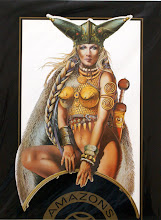
For nearly the whole run, the artist was Andrew J. Wilson whose loose, flowing style is not to be mistaken for the other Sue Day artist, whose work – stylistically similar to the artwork of W. Bryce-Hamilton – appeared in the Princess Picture Library and who occasionally filled-in for Wilson on the main weekly strip.
Wilson's only other known strip for Princess Tina was 'Lassie Come Home'. After the adventures of the Day family came to an end, he disappears from view – probably to D. C. Thomson's girls' papers – before reappearing briefly at Fleetway drawing adventure strips for Buster, where he took over 'The Runaways' from Joe Colquhoun. 'The Byrds of Paradise Island' (1978-80) and 'Johnny's Journey' (1980) are his last known work.
Examples of Andrew Wilson's artwork can be found for sale at the Illustration Art Gallery.
Subscribe to:
Posts (Atom)


