Illustration Art Gallery

The very best from the wide, sometimes overlooked, world of illustration art, including original artwork for book illustrations and covers, comic books and comic strips, graphic novels, magazines, film animation cels, newspaper strips, poster art, album covers, plus superb fine art reproductions and high quality art prints.

Our gallery brings together artists from all over the world and from many backgrounds, including fantasy, horror, romance, science fiction, education, sport, history, nature, technology, humour, glamour, architecture, film & tv, whimsy, even political satire and caricature.

Wednesday, November 28, 2012

Mary A Brooks

 
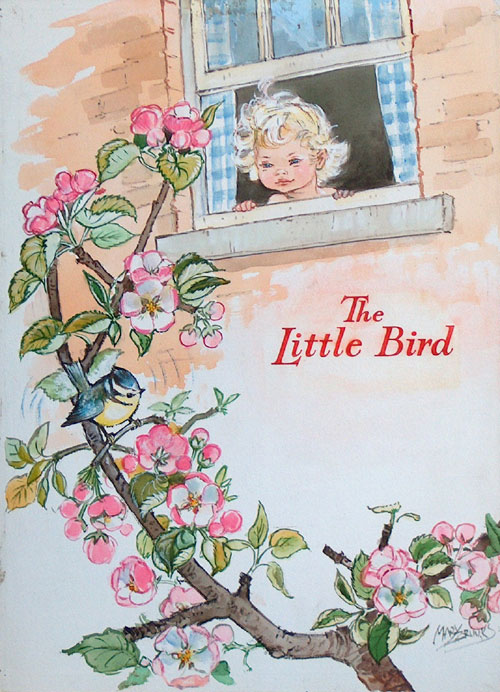
Mary Brooks (1922- ) was the illustrator of Enid Blyton's Noddy Gets Into Trouble (1954) and Noddy Meets Father Christmas (1955), having earlier contributed to The Enid Blyton Holiday Annual at least as early as 1951. She wrote and illustrated many books for nursery-age children in the 1960s ranging from early learning titles like One, Two, Three—123 (1966) and ABC—123 (1966) to illustrated animal books, books of rhymes and fairy stories.

Her artwork was, according to one online commentator, "charming and highly detailed whilst retaining a soft edge, and is often aimed at younger children. She was celebrated especially for her illustrated stories centering on animal family life." She also illustrated a number of nature scenes for Treasure magazine.

Her work appeared in a number of books published by Purnell (1978-80) and Dean (1986-87) and it is said that, even in her late eighties, she continues to paint.

Mary A. Brooks was married to Laurence William Penn in Dartford, Kent, in 1947. He died in 1989, aged 73.

PUBLICATIONS

Books
Evacuees. London & Bognor Regis, John Crowther, 1942.
Green Bacon. London & Bognor Regis, John Crowther, 1942.
Goggle the Frog (as M. B. Brooks). London, W. H. Cornelius (Success series), 1945.
Who Will Play With Me? London, Golden Pleasure Books, 1963.
One, Two, Three, 1, 2, 3. London & Melbourne, Ward Lock & Co., 1966.
Animal Adventures. London, Ward Lock, 1967.
Animal Paradise. London, Ward Lock, 1967.
Animal Wonderland. London, Ward Lock, 1967.
The Adventures of Rufus. London, Ward Lock, 1969.
Frisky and her Friends. London, Ward Lock, 1969.
Nursery Rhymes. London, Ward Lock, 1969.

Books Illustrated
Kimba by Paddy Smith. London, W. H. C., 1945 [Mary B. Brooks?]
The Adventures of Peppity the Pixie by Shirley M. Graham. London & Melbourne, Ward, Lock & Co., 1952.
Little Kanga's Pocket by Marie A. Battersby. London, Sampson Low, 1952.
Fun in Twistle Wood by Paddy Smith. London & Glasgow, Blackie & Son, 1953.
The Lonely Little Turtle by Marie A. Battersby. London, Sampson Low, 1953.
Grimm's Fairy Tales. London, Ward Lock, 1955.
Kandy meets the Bunny-Babes by David White. London, Sampson Low, 1957.
Kandy in Bunny-Babe Land by David White. London, Sampson Low, 1958.
Field Folk (verse) by Brenda G. Macrow. London, Blackie, 1958.
The New Big Sleep Book by Sheila Hodgetts. London, Sampson Low, 1959.
The Hat by Nova Rock, London & New York, Frederick Warne & Co., 1960.
Bobo and the Crocodile by Nova Rock. London & New York, Frederick Warne & Co., 1961.
Babies of the Wild (verse) by Brenda G. Macrow. London & Glasgow, Blackie, 1962.
Calling All Bears by Lilias Edwards. London, Peal Press, 1964.
Sleepy Time Tales by Sheila Hodgetts. London, Purnell, 1964.
ABC 123. London, Ward Lock, 1966.
Bo-Peep Rhymes. London, Sandle Brothers, 1966.
Calling All Pets by Lilias Edwards. London, Peal Press, 1966.
Hey Diddle Diddle Rhymes. London, Sandle Brothers, 1966.
Simple Simon Rhymes. London, Sandle Brothers, 1966
Jack and Jill Rhymes. London, Sandle Bros. & Ward Lock & Co., 1969.
Seven Little Australians, adapted from the story by Ethel Turner. London, Ward Lock, 1975.
Before I Go To Sleep by Barbara Hayes. Maidenhead, Purnell, 1978.
Baby Animal Stories by Barbara Hayes. Maidenhead, Purnell, 1979.
Sleepy Time Tales by Barbara Hayes. Maidenhead, Purnell, 1979.
Peppy the Little Fairy, and nine other tales by Barbara Hayes. Maidenhead, Purnell, 1980.
Pixie Peapod, and nine other tales by Barbara Hayes. Maidenhead, Purnell, 1980.
Pook Goes Bump, and nine other tales by Barbara Hayes. Maidenhead, Purnell, 1980.
Pucki the Piper, and nine other tales by Barbara Hayes. Maidenhead, Purnell, 1980.
A Visit to Fairyland by Barbara Hayes. Maidenhead, Purnell, 1980.
Best of Friends (verse) by Stewart Cowley. London, Dean, 1986.
Happy Days (verse) by Stewart Cowley. London, Dean, 1986.
In the Sunshine (verse) by Stewart Cowley. London, Dean, 1986.
Talking to God: Children's Prayers for Every Day by Barbara Hayes Page. Twickenham, Dean, 1987.
Favourite Toys (verse) by Stewart Cowley. London, Dean, 1988.

You can find examples of Mary Brooks's artwork at the Illustration Art Gallery.

Wednesday, November 21, 2012

Terry Bave

One of the stalwarts of British humour strips, Terry Bave retired in 2007 to enjoy some well-earned rest after worked in comics for 40 years. Bave's clear, unfussy humour strips were to be found in great numbers – he worked on six or seven characters at any one time – in Fleetway's humour comics in the 1970s, '80s and '90s.

Terence H. Bave was born in Bristol, Gloucestershire, in 1931. Inspired by American films and comics, which Bave sought out at newsagents selling American newspapers, he began drawing at an early age. His general education was disrupted by family moves and being twice evacuated during World War II. Bave estimated he attended eleven schools in as many years.

Returning to London in 1945, Bave took on full time work as  a clerical assistant at the Post Office Savings Bank. One day a week he attended the Brook Green Day Continuation School until he was sixteen. It was here that he met Sheila Newton, who subsequently also worked at the Post Office bank.

From filling the margins and covers of his exercise books to posting regular topical cartoons on the Post Office bank notice board, Bave decided to turn his artistic inclinations into a career. At the age of seventeen he joined the Colonial Survey Department as a trainee cartographer, drawing maps with the aid of aerial photography. His first published cartoon was in the department’s magazine, The Drum.

Bave’s combined interest in films and cartoons led to his first professionally published cartoons in the pages of the film magazine Picturegoer and the home movie magazine The Pathescope Gazette. With this success in specialist magazines, Bave sought out others and, by the late 1950s, was also publishing regularly in Do-It-Yourself, TV Times, Fire! and Scooter. In a year, Bave could earn £100 from his cartoons. By then, he had joined a firm of commercial map makers but was contemplating another move. A commission to draw a cartoon design for a dog ointment carton led to an offer of work as a packaging designer for Stable Cartons Ltd.; Bave later moved to C. H. G. Jourdan Ltd. where he successfully designed fancy packaging during the heady days of the psychedelic sixties. At the same time, he became the art editor of The 9.5 Review, put together by enthusiasts of home movies following the demise of The Pathescope Gazette.

In 1967, and still keen to work in comics, Bave targetted Wham!, a recently-launched comic published by Odhams Press. Invited to meet editor Albert Cosser at the publisher’s Long Acre office, he was offered the opportunity to take over the strip “Sammy Shrink”, about a nine-inch-tall boy with normal-sized parents, which was languishing in the lower regions of the popularity charts.

Bave and his wife created their own character, “Baby Whamster”, a half-pager which they also scripted; he proved immediately popular as a mascot for Wham! and “Baby Smasher” was added to the line-up of Wham!’s sister paper, Smash!.

Bave was determined to make a go of comics and used every opportunity to learn more about what his audience wanted, particularly by involving himself in the school attended by his son, Russell (born in 1959). He helped with the school magazine, performed as a ventriloquist at school fetes and wrote a school play.

With the addition of work for annuals and worked sourced locally (including posters, letterheads, leaflets, display advertising, cartoons, etc.), Bave was able to turn freelance. However, Wham! was soon to be merged with Pow!, which promptly folded a few months later. Bave found work on annuals via King Leo Studios but that had all but dried up when the Baves received a letter from Jack Le Grand offering them work on a new paper. This was Whizzer & Chips, a title unlike any other on the market in that it was two comics in one.

Bave created some thirteen possible strips and was invited to write (with Sheila) and draw however many he could reasonably cope with on a weekly basis. Thus, when Whizzer & Chips debuted on 18 October 1969, it featured six strips by Bave: the full-page “Me and My Shadow”, “Ginger’s Tum”, “Hetty’s Horoscope” and “Aqua Lad”, plus half-pagers “Puddin’ Tops” and “Karate Kid” – to which “Nipper” was soon added.

Of these, “Me and My Shadow”, in which young ‘Smudger’ Smith is in constant battle with his own shadow, “Puddin’ Tops”, a brother and sister named after their pudding-top hairstyles, and “Karate Kid”, inspired by their son’s taking up of judo lessons, lasted until the mid-1970s.

One of Bave’s rejected ideas, “Eager Beavers”, was picked up by Buster, where it ran for eighteen months. The new comic Cor!! included Bave’s “Donovan’s Dad” and “Andy’s Ants”. In 1970, Bave and his family moved to a bungalow in Bembridge, on the Isle of Wight, where he and Sheila were to live for over forty years.

Promotional issues often involved creating new characters, and Bave’s creativity gave Whizzer & Chips “Jimmy Jeckle and Master Hide”, “The Scarey’s of St. Mary’s” and, most successfully, “The Slimms” in Cor!!, which capitalised on the contemporary slimming craze – although the portly Mum and Dad in the story had no desire to slim; it was their son, Sammy, who tried different ways each week to help them stick to diets or get some exercise. When Cor!! folded in 1973, the strip moved to Whizzer & Chips where it ran until 1979.

Another ‘two-in-one’ comic, Shiver &Shake, featured the spider “Webster” and, after a ghosting the strips on occasion, took over the lead characters of both sections, “Shiver” the ghost and “Shake” the elephant. New for Knockout was “My Bruvver”, in which poor Len is stuck each week with his tearaway younger brother, the little’un. “Sammy Shrink” was revived in Knockout before transferring to Whizzer &Chips and Bave also took over “Desert Fox” in Shiver and Shake and “Odd Ball” in Whizzer &Chips, the latter about a ball that could stretch and morph into any shape. Truly odd, it proved to be one of Bave’s longest-running strips, surviving in Whizzer & Chips until 1990.

The launch of Whoopee in 1974 brought with it two new Bave creations, “Toy Boy” (who, as his name implied, loved toys) and “Stoker, Ship’s Cat”, a hungry cat in the mould of Ginger. Other cat characters from Bave’s pen included “Police Dog and Cat Burglar” (Whizzer & Chips, 1975) and “Scaredy Cat” (Krazy, 1976-78). 1978 saw the creation of “Calculator Kid” for Cheeky Weekly but the late 1970s saw the merging of various papers, leaving Bave contributing only to Whizzer & Chips, Whoopee and various annuals and summer specials as the decade turned.  “Barney’s Badges” (Wow!, 1982-83), “Good Guy” (Buster, 1983) and the feature “Top Class Comics” (School Fun, 1983-84) kept Bave busy.

The latter half of the 1980s saw fewer new releases from Fleetway, although Bave continued to contribute new characters, including “Pete’s Pop-Up Book” (Buster, 1985-88), “Double Trouble” (Nipper, 1987, Buster, 1987- ), “Mighty Mouth” (Nipper, 1987; Buster, 1987-90), “Melvyn’s Mirror” (Buster, 1990), “The Figments of Phil’s Imagination” (Buster, 1991-94) and “Imagine” (Buster, 1991).

Fleetway’s line of humour titles shrunk further, Whizzer & Chips finally merging with Buster in 1990 and Buster becoming a fortnightly in 1995, eventually folding in 2000. By then, Bave had established himself with rivals D. C. Thomson, ghosting a number of strips – including ‘Number 13’ and ‘Bash Street Kids’ for Beano before taking over ‘Winker Watson’ in Dandy (1991-2002). Over the next few years, Bave’s creations included ‘The Great Geraldoes’ (Beano, 1992-93), ‘Buster Crab’ (Dandy, 1998), ‘Inspector Horse and Jockey’ (Beano, 1999-2000 – a parody of Inspector Morse) and ‘Baby Herc’ (Dandy, 2003).

Examples of Bave's artwork can be found at the Illustration Art Gallery.

Wednesday, November 14, 2012

Janet Blakeley

Janet Blakeley was a regular contributor to Look and Learn and was one of their most prolific artists for nature articles in the late 1970s, appearing almost every week.

She also contributed illustrations to Watching Wildlife by Andrew Cooper (London, Usborne, 1982) and the children's novel Alice's Part by Vera Boyle (London, Macmillan Children's Books, 1983).

Artwork by Janet Blakeley can be found at the Illustration Art Gallery.

Wednesday, November 7, 2012

Angel Badia Camps

Ángel Badia Camps was born in Puig-reig, in the Cataluña area of Spain, which borders southern France, in 1929. His father was exiled to France following the Spanish Civil War, only returning after nine years when Franco offered a conditional amnesty and allowed him to return and move with his family to Barcelona.

His love of drawing had begun early and Camps was encouraged by his parents but his knowledge of comics was limited to En Patufet and his education came with the discovery of American comics at the Sant Antonio market. Camps developed a fascination with American culture – with artists Milton Caniff and Alex Raymond and the films of John Ford and Howard Hawks, with American literature and the music of Glen Miller and jazz.

Camps attended the Escuela Superior de Bellas Artes. He began working professionally in Ameller, drawing fairy stories, and his work began appearing regularly in Florita, Aventuras de Capa Negra (17 issues written by Salvador Dulcet, 1953) and Pulgarcito (1954).

Although he drew comic strips, including the humorous stories of "Pilaropo al servicio de las damas" for La Risa (1956) and medieval historical tales Aventuras de Flecha Roja [Adventures of Red Arrow] (1956-57) and Flecha y Arturo (1956) for Ediciones Gráficas Ricart.

However, it was his work for romance comics such as "Marisol" (Lupita, 1950), Mariló, Sentimentale, Modelo, Dalia, Merche and Sissi that he established himself. He illustrated Bernadette (1956) for Editorial Bruguera. Through this romantic work, Camps developed a lengthy association with the British romantic comics' market, first appearing in Valentine in 1961. Over the next few years he contributed strips to Serenade, Roxy and True Life Library (1964). According to David Roach, "At first glance his drawing style was almost indistinguishable from [Jorge] Longaron's as he mixed a thrillingly loose and expressive line with an inventive and sophisticated sense of composition. His girls were the very epitome of 'the Spanish look' – heavy-lidded, thickly mascara'd eyes, big hair, big lips and lithe, languid bodies."

To give his work accuracy, Camps travelled to the UK and took over 300 reference photos of hospitals, buses, bridges, streets... everything had to be English which was not entirely a chore as his work coincided with the era of The Beatles, swinging London models and MG sports cars.

Camps is perhaps better known in the UK as a cover artist. Following his first appearance in 1960 on the Sexton Blake Library, he produced hundreds of covers for True Life Library, Star Love, Love Story Library, Oracle, Pop Pic Library, Charm, Young Lovers and other titles. The 1950s and 1960s were the heyday of magazine illustration before colour photography became the norm and Camps's paintings were widely reprinted throughout Europe and Scandinavia, often appearing in women's magazines before being reused as covers elsewhere.

For his native Spain, Camps produced heavily illustrated translations of Heidi (1966) and Otra Vez Heidi (1966), based on the works of Juana Spyri, Los Hijos del Capitan Grant (1968) and Viaje al Centro de la Tierra (1969), both by Jules Verne, Aventuras de Tom Sawyer (1969) by Mark Twain and stories featuring Robin Hood (by Norman R, Stinnet) and Davy Crockett (by Elliot Dooley) for Editorial Bruguera.

By the late 1960s, he was working again almost exclusively for Spanish markets, Editorial Bruguera employing him on various lines of paperbacks, including Libro Amigo, La Conquista del espacio, and
Selección Terror. Camps also produced work for Molino, Toray and Ceres.

Although he was still earning a good living, and demand for cover artwork slowed in the 1980s as video became a more popular form of home entertainment than reading, Camps set up a school with fellow artist Rafael Cortiella, which ran for ten years. Camps subsequently concentrated on painting, although he had been exhibiting paintings since 1974.

Camps relates the story that he was painting whilst on holiday in Olot when the owner of a Barcelona gallery approached him and asked if he had ever exhibited his work. Camps said he was merely a Sunday painter but the gallery owner was persistent. "He asked if he could come to my studio and took almost everything I had." His work has, from 1986, featured in numerous solo exhibitions in Madrid, Barcelona, London, Brussels, Castellon and New York. His most regular exhibitor is the prestigious Sala Pares in Barcelona.


Examples of Angel Badia Camps' artwork can be found at the Illustration Art Gallery.
Wednesday, October 31, 2012

Roland Green

Roland Green was a noted nature artist, particularly known for his pictures of birds, which he painted in oils and watercolours.

He was born Roland Green in Rainham, Kent, in January 1890, the son of Roland Green, a taxidermist, and his wife Emily Filmer (nee XXXX), whom he married in the 1880s. Roland was their third child and first son, following Ivy (1885) and Daisy Eunice (1886). According to one biography, Green's father "taught him how to skin, stuff and set up birds, which gave Roland a fine knowledge of anatomy and plumage. Whilst at school he showed a gift for drawing and painting birds and went on to study at the Rochester School of art as well as Regent Street Polytechnic."

By 1911, Green was working as an artist/lithographer in London, the family having moved to Seven Kings, Essex, where Green's father was now employed as a joiner in the building trade. He later moved to Hickling in Norfolk, where his work attracted the attention of Lord Desborough, owner of the Hickling Estate. Green was commissioned to paint the frieze on the walls of Whitelea Lodge depicting the birds of the Hickling Broad.

Green illustrated a number of books, including contributions to The Birds of Australia by Gregory Mathews (London, Witherby, 12 vols., 1910-27) following the death in 1912 of J. G. Keulemans, who illustrated the first four volumes. Other books include Birds in Flight by W. P. Pycraft, The Bird Book by Enid Blyton, Wing to Wing by E. H. Ware  and The Ladybird Book of British Wild Animals by George Cansdale.

Green died in Norfolk in 1972, aged 82. He never married. A large collection – 120 watercolours and 7 oil paintings – of Green's artwork amassed by Commander David Joel, a schoolboy when he was first introduced to Green, was sold in 2012 with profits going to the Norfolk Wildlife Trust and the Norfolk and Norwich Naturalists' Society.

Joel said in an interview: "There was not anyone on the Broads who did not know about Roland Green. He lived in the reedbeds and people thought he was a hermit, but he was anything but. He was an extrovert who gave talks at school and loved enthusing children with his love of art ... Modern artists use photographs but Green worked only from observation and that is why his birds look absolutely real." Joel has written a tribute to Green, A Homage to Roland Green – His Norfolk Legacy (2012), published by St. Barbe Museum and Art Gallery, Lymington.

Note: Wikipedia gives his name as Roland J. Green, but there is no record of Green having a middle name or initial.

PUBLICATIONS

Non-fiction
Wing-Tips: The Identification of Birds in Flight. London, A. & C. Black, 1947.
Sketching Birds. London, Royal Society for the Protection of Birds, 1948.
How I Draw Birds: A Practical Guide for the Bird-Watcher. London, A. & C. Black, 1951.

Illustrated Books
The British Bird Book by the Rev. Canon Theodore Wood and W. P. Pycraft. London, A. & C. Black, 1921.
Birds One Should Know, Beneficial and Mischievous by Rev. Canon Theodore Wood. London, Gay & Hancock, 1921.
Birds in Flight by W. P. Pycraft. London, Gay & Hancock, 1922.
Birds and Their Young by T. A. Coward. London, Gay & Hancock, 1923. The Bird Book by Enid Blyton. London, George Newnes, 1926.
Ornithologist's Field Note Book by Ronald M. Garnett. Holt, Norfolk, Rounce & Westley, 1932. [Frontispiece]
How to Look at Birds by Thomas Lewis Bartlett. London, Royal Society for the Protection of Birds, 1945.
The Children's Book of British Birds and Verses by Katherine Lloyd. London, Foy Publications, 1946.
British Birds by Wilfred Willett. London, Foy Publications, 12 vols., 1946-47.
Wing to Wing by E. H. Ware. London, Paternoster Press, 1946.
British Birds in Their Haunts by the late Rev. C. A. Johns, illus. with William Foster; 25th ed. edited & revised by W. B. Alexander. London, Routledge & Kegan Paul, 1948.
The Ladybird Book of British Wild Animals by George Cansdale. Loughborough, Ladybird Books, 1958.
Birds of Cyprus by David A. Bannerman & W. Mary Bannerman, illus. with D. M. Reid-Henry. Edinburgh, Oliver & Boyd, 1958.

Examples of Roland Green's artwork can be found at the Illustration Art Gallery.

Wednesday, October 24, 2012

Robert Nixon

Robert Nixon was a regular contributor to The Beano for many years, best known for his  work on the likes of "Roger the Dodger" and "Lord Snooty". Nixon's clean line and storytelling talents meant that word balloons were scarcely necessary for readers to follow the action. Nixon had a talent for ghosting styles, whether they were Ken Reid, Leo Baxendale or Dudley D. Watkins, but brought to his artwork a distinctive cuteness. Nixon's editor at The Beano told The Guardian that Nixon would have been able to illustrate a note to the milkman and still make it look appealing.

Robert Thomas Nixon was born in South Bank, near Middlesbrough in North Yorkshire, on 7 July 1939, the fifth of six children born to Arthur W. Nixon, a steelworker, and his wife Phyllis (nee Thompson), who had married in 1931. He was educated at Cromwell Road School and the Central Secondary Modern School, both in South Bank, where his youthful artistic talents were encouraged. He won several art competitions and earned himself a scholarship to Middlesbrough Art College in September 1954 but he became disillusioned with the course and dropped out. Instead, he found work as an apprentice lithographer and photo-retoucher at a printing factory. That same year, 1955, his father died at the early of 49.

Nixon married Rita M. Kelly in Middlesbrough in 1961 and had four children: Paul H. (1962), Anthony R. (1964), Wendy Anita (1966) and Catherine Ann (1968).

A fellow student encouraged him to try cartooning and he began trying his hand at cartooning, submitting samples to D. C. Thomson. His first success was to produce three fill-in episodes for The Beano's "Little Plum", the first published in April 1964. Later that year, Ken Reid departed from The Beano and Nixon took over his "Roger the Dodger", which he continued to draw until 1973. He turned freelance and 1965, soon after which the family moved to Guisborough, Cleveland.

In 1968, Nixon inherited "Lord Snooty" from Dudley D. Watkins. Later strips for Thomsons included "Esky Mo" (1969) and "Captain Cutler" (1972) for Sparky and "Grandpa" for The Beano (1971).

Nixon was offered work – and the higher page rate of £17 as opposed to £12 a page – by IPC Publications, who were expanding their range of humour titles following the success of Whizzer & Chips and he began contributing "Hire a Horror" and "Ivor Lott and Tony Broke" to Cor!! in 1972 and "Soggy the Sea Monster" and "Frankie Stein" in Shiver & Shake in 1973. This work enabled him to work full-time for IPC, who soon added Whoopee!, Monster Fun and Krazy to their line-up of titles, to which Nixon contributed "King Arthur and His Frights of the Round Table" (1974), "Kid Kong" (1974) "12½p Buytonic Boy" (1976).

Nixon drew "The Gems", written by Trevor Metcalfe, for The Sun newspaper for eighteen months in 1976-78, but his main output continued to be weekly strips for IPC. He took over "Gums" for Buster and "Kid King" for Jackpot as well as creating "Laser Eraser" for the latter (1979); "Elephant on the Run" (1978) and "Stage School" (1979) ran in Cheeky Weekly and "Ossie" (1982) and "Family Trees" (1983) in Wow!. During this period, he also drew "Parkie" (1982) for a local newspaper, the Middlesbrough Evening Gazette. At his peak he was producing nine pages a week.

After fifteen-years, the newly appointed editor of The Beano, Euan Kerr, tried to tempt him back but without success. Later that same week, the editor of IPC's humour titles called with the news that mergers would leave him with fewer pages to work on; Nixon contacted Kerr and asked if the offer of work was still open.

Nixon was tempted back to D. C. Thomson, where his first "Roger the Dodger" strip appeared in January 1985. Nixon's favourite amongst the characters he created debuted in The Beano later that same year: "Ivy the Terrible",followed by "Willie Fixit" (1985) in Topper and "Polar Blair" (1985) for the newly launched Hoot.

Nixon took over the artwork for both "Korky the Cat" (The Dandy) and "Beryl the Peril" (Topper) in 1986, and continued to draw various other strips for The Beano, including "Little Monkey" (1987) and "Roger's Dodge Clinic" (1989). Nixon also illustrated related merchandise, including jigsaws and Easter egg boxes.

As an artist, Nixon had already illustrated cartoon greetings cards for the Noel Tatt Company and joke books written by Gyles Brandreth. In his spare time, he enjoyed painting fantasy landscapes in oils, pastels and watercolours.

Nixon continued to draw until his death on 22 October 2002, aged 63, his final page – the cover for the Beano Summer Special (2003) – arriving the day before he died. His longest-running strip, "Roger the Dodger" was continued by Barrie Appleby for some years and a series of Nixon reprints were introduced in 2011 before Appleby returned the following year.

Books Illustrated
More Crazy Jokes by Janet Rogers. London, Beaver, 1980.
Amazing Facts About the Living World by Derek Hall, illus. with Stephen Lings. London, Beaver Books, 1983.
Crazy Practical Jokes by Janet Rogers. London, Beaver, 1983.
The Crazy Joker's Handbook by Janet Rogers. London, Beaver, 1984.
The Rudest Joke Book in the World by Gyles Brandreth, Sevenoaks, Knight, 1985.
The Joke-a-Day Fun Book by Janet Rogers. London, Beaver, 1986.
Crazy Jokes by Gyles Brandreth, illus. with Graham Thompson & John Smyth. London, Madcap, 1997.
Crazy Practical Jokes by Gyles Brandreth. London, Madcap, 1997.
Bumper Book of Laughs by Gyles Brandreth, illus. with Colin Hawkins, Sara Silcock. London, Madcap, 1999.

Examples of Robert Nixon's artwork can be found at the Illustration Art Gallery.

Wednesday, October 17, 2012

Harry Green

A little-known artist, Harry Green (1920- ) contributed extensively to Look and Learn in the 1970s and 1980s, illustrating a variety of subjects ranging from historical buildings to football. However, it was as a transport illustrator that he really made his mark in the 1980 with the series "Britain's Railway Wonders". Green also contributed illustrations to Speed & Power in the 1970s.

His book illustrations include Architecture (1969), Architecture: The Great Art of Building (1969), Discovery of Australia (1969) and Discovery of South America (1970), some of which were jointly illustrated by Gwen Green who was also a prolific children's educational book illustrator.

Examples of Harry Green's artwork can be found at the Illustration Art Gallery.