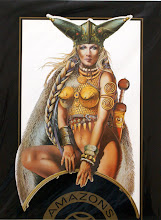
Kenneth J. Wood was a popular nature artist who was especially know for his detailed paintings of birds.
Little seems to have been published about Wood. He was a keen falconer and member of the British Falconers' Club and is remembered fondly by many in those circles. At some point in his career he lived in a caravan near Findon, West Sussex. He was the Hon Secretary of the Society of Wildlife Artists from 1983 until the 1990s. He died suddenly whilst still young: taken ill whilst hawking, he was diagnosed with cancer.
Examples of original art by Kenneth J. Wood can be found at the Illustration Art Gallery.
Wednesday, December 28, 2011
Wednesday, December 21, 2011
Gerry Wood
Although his name is recognised amongst British comic fans, little is known about Gerry Wood. He is probably best known as an illustrator, working in the 1970s in World of Wonder, Look and Learn and Speed and Power, which culminated in 1977 with his taking over the artwork for what was, by then, entitled 'More Adventures of the Trigan Empire'.
Wood seems to have begun working in the early 1960s for Battle Picture Library, then drawing for Air Ace and Micron's Combat Picture Library. His book illustrations include Sky Carnival by W. F. Hallstead (1969). He returned to Air Ace in 1970 before producing his first comic strip in colour, 'A Leap Into the Future' for the early issues of World of Wonder.
A later job was to draw a pull-out poster for Battle Picture Weekly in 1976. He continued to illustrate educational books following the demise of Look and Learn, including Pyramids by Anne Millard (1989), Roman Fort by Fiona Macdonald (1996) and Ancient African Towns by Fiona Macdonald (1998).
Examples of original artwork by Gerry Wood can be found at the Illustration Art Gallery.
Wood seems to have begun working in the early 1960s for Battle Picture Library, then drawing for Air Ace and Micron's Combat Picture Library. His book illustrations include Sky Carnival by W. F. Hallstead (1969). He returned to Air Ace in 1970 before producing his first comic strip in colour, 'A Leap Into the Future' for the early issues of World of Wonder.
A later job was to draw a pull-out poster for Battle Picture Weekly in 1976. He continued to illustrate educational books following the demise of Look and Learn, including Pyramids by Anne Millard (1989), Roman Fort by Fiona Macdonald (1996) and Ancient African Towns by Fiona Macdonald (1998).
Examples of original artwork by Gerry Wood can be found at the Illustration Art Gallery.
Wednesday, December 14, 2011
Maurice Wilson
Born in London on 15 March 1914, Maurice Charles John Wilson was best known as a wildlife artist whose work appeared in dozens of books and on cards given away with Brooke Bond tea. He was educated at the Hastings School of Art (under Philip Cole) and the Royal Academy Schools (under Malcolm Osborne and Robert Austin) and later taught anatomical and plant drawing. He worked with members of the Natural History Museum in reconstructing the look of dinosaurs from fossils and his work in this area was much respected, inspiring books such as A History of Primates (1949), Fossil Amphibian and Reptiles (1954), Fossil Birds (1958) and Human Evolution: An Illustrated Guide (1989).
Wilson wrote and illustrated Just Monkeys (1937). After the war he illustrated dozens of books, including Dogs (1946), Coastal Craft (1947), Zoo Animals (1948), A Guide to Earth History (1956), Birds and Beasts (1956), Mermaids and Mastadons: A Book of Unnatural History (1957), Elephants (1958), Animals We Know (1959), Fables from Aesop (1961), Donkey Work (1962), A World of Animals (1962), Animals (1964), Animals of the Arctic (1964), Birds (1965), The Origins of Man (1968), First Interest on the Farm (1969), A Long Time Ago (1969-70), Patch by Helen Griffiths (1970), Man, Civilzation and Conquest (1971), China Long Ago (1972), First Interest in the Wider World (1972), Double Trouble by Doreen Tovey (1972), Making the Horse Laugh by Doreen Tovey (1974), The Earliest Farmers and the First Cities (1974), The Quzzer Book About People (1975), Oh Those Cats by Frances Mann (1975), A Quorum of Cats: An Anthology ed. Elizabeth Lee (1976), Bambi by Felix Salten (1976), Prehistoric Animals (1976), A Closer Look at Arctic Lands (1976), Prehistoric Animals (1976), A Closer Look at Plains Indians (1977), A Closer Look at Eskimos (1977), Ponies (1977), Birds of Prey (1978), A Closer Look at Amazonian Indians (1978), A Closer Look at the Bedouin (1978), Cats in the Belfry by Doreen Tovey (1978), Horses (1979), Lions and Tigers (1979), A Closer Look at Aboriginies (1979), Birds (1979), A Comfort of Cats by Doreen Tovey (1979), A Closer Look at Grasslands (1979), Lifeclass (1980), The Jungle Book by Rudyard Kipling (1983), The Second Jungle Book by Rudyard Kipling (1984), All the Mowgli Stories by Rudyard Kipling (1984), Lions and Tigers (1985) and Deserts (1986).
Wilson lived in Tunbridge Wells, Kent, where he died in November 1987.
Wilson's autobiography, The Wartime Adventures of B Squadron 'Corpse' (1997), was publishing posthumously, relating how he joined the 11th Battalion Royal Tank Regiment in 1941 and spent much of the war in a Matilda tank, weathering sandstorms in the Middle East, taking part in the landings at Walcheren and in the 'CDL' experiment which involved placing blindingly bright carbon arc lamps in the turrets of tanks to create a wall of light when the tanks were lined up—an idea that was never used in battle.
Many of his illustrations were produced to accompany displays at the Natural History Museum and many can be found in the Natural History Museum's Collection.
Examples of Maurice Wilson's original artwork can be found at the Illustration Art Gallery.
Wednesday, December 7, 2011
Gahan Wilson
Gahan Wilson is an American cartoonist, best known for his work in Playboy and The New Yorker. A 2009 collection celebrating Wilson's Fifty Years of Playboy Cartoons ran to 3 volumes and 942 pages. A master of the fanciful and macabre, Wilson has also contributed regularly to The Magazine of Fantasy and Science Fiction, Collier's and National Lampoon, which ran his comic strip 'Nuts'.
Born in Evanston, Illinois on 18 February 1930, Wilson was the only child of a successful executive in a steel company and a talented artist in a Chicago advertising firm. He has described his upbringing as dysfunctional due to his partents' alcoholism, although he was also encouraged to draw. From an early age his drawings featured elements of horror and he became a fan of Chester Gould's 'Dick Tracy', with its many grotesque characters, and 'Little Orphan Annie' by Harold Gray. Radio also played an important part in his childhood love of the mysterious and macabre, as did Hollywood. Through a family friend he was able to visit Hollywood studios in the 1940s.
Wilson attended a number of commercial art studios whilst in High School and studied fine art at the Art Institute of Chicago. He was briefly in the Air Force but a bad leg excluded him from active duty. He then moved to Greenwich Village, selling cartoons to the major weekly magazines Collier's and Look.
Wilson attempted approach to Harvey Kurtzman following the launch of Trump resulted accidentally in his introduction to Hugh Hefner. He had spotted a Chicago address in Trump and visited the offices when he returned to Chicago to visit his parents over Christmas. Trump was, in fact, edited in New York, but Wilson found himself introduced to Hefner who began running his colour cartoons in Playboy in the mid-1950s.
Although best known for his single panel cartoons, Wilson produced 'Nuts' for National Lampoon as a response to Charles Schultz's 'Peanuts' where children would philosophise about any subject; 'Nuts' was Wilson's response of what it was really like to be a little child. Wilson ended the strip when he discovered it was being sold abroad, although he did subsequently return to the paper. Wilson also produced a syndicated weekly strip under the title 'Gahan Wilson's Sunday Funnies'.
Wilson's first collection of cartoons appeared in 1965 as Gahan Wilson's Graveside Manner and was followed by many other books, including collections of short stories and novels for both adults and children. He was also a film reviewer for The Twilight Zone Magazine, a book reviewer for Realms of Fantasy and designed a computer game, Gahan Wilson's The Ultimate Haunted House.
Wilson's cartoons have earned him a number of awards, including World Fantasy Convention Award in 1981, the World Fantasy Lifetime Achievement award in 2005 and the Milton Caniff Lifetime Achievement Award in 2005 from the National Cartoonists Society. He has also been President of the Cartoonist Guild. He was the subject of a documentary directed by Steven-Charles Jaffe entitled Gahan Wilson: Born Dead, Still Weird.
Examples of Gahan Wilson's original artwork can be found for sale at the Illustration Art Gallery.
Born in Evanston, Illinois on 18 February 1930, Wilson was the only child of a successful executive in a steel company and a talented artist in a Chicago advertising firm. He has described his upbringing as dysfunctional due to his partents' alcoholism, although he was also encouraged to draw. From an early age his drawings featured elements of horror and he became a fan of Chester Gould's 'Dick Tracy', with its many grotesque characters, and 'Little Orphan Annie' by Harold Gray. Radio also played an important part in his childhood love of the mysterious and macabre, as did Hollywood. Through a family friend he was able to visit Hollywood studios in the 1940s.
Wilson attended a number of commercial art studios whilst in High School and studied fine art at the Art Institute of Chicago. He was briefly in the Air Force but a bad leg excluded him from active duty. He then moved to Greenwich Village, selling cartoons to the major weekly magazines Collier's and Look.
Wilson attempted approach to Harvey Kurtzman following the launch of Trump resulted accidentally in his introduction to Hugh Hefner. He had spotted a Chicago address in Trump and visited the offices when he returned to Chicago to visit his parents over Christmas. Trump was, in fact, edited in New York, but Wilson found himself introduced to Hefner who began running his colour cartoons in Playboy in the mid-1950s.
Although best known for his single panel cartoons, Wilson produced 'Nuts' for National Lampoon as a response to Charles Schultz's 'Peanuts' where children would philosophise about any subject; 'Nuts' was Wilson's response of what it was really like to be a little child. Wilson ended the strip when he discovered it was being sold abroad, although he did subsequently return to the paper. Wilson also produced a syndicated weekly strip under the title 'Gahan Wilson's Sunday Funnies'.
Wilson's first collection of cartoons appeared in 1965 as Gahan Wilson's Graveside Manner and was followed by many other books, including collections of short stories and novels for both adults and children. He was also a film reviewer for The Twilight Zone Magazine, a book reviewer for Realms of Fantasy and designed a computer game, Gahan Wilson's The Ultimate Haunted House.
Wilson's cartoons have earned him a number of awards, including World Fantasy Convention Award in 1981, the World Fantasy Lifetime Achievement award in 2005 and the Milton Caniff Lifetime Achievement Award in 2005 from the National Cartoonists Society. He has also been President of the Cartoonist Guild. He was the subject of a documentary directed by Steven-Charles Jaffe entitled Gahan Wilson: Born Dead, Still Weird.
Examples of Gahan Wilson's original artwork can be found for sale at the Illustration Art Gallery.
Wednesday, November 30, 2011
Colin Wilson
Although primarily known in the UK as a 2000AD artist, it would be fair to say that Colin Wilson probably has one of the broadest fan bases of any artistic contributor to Britain's longest running boys' weekly. Whilst many artists have found popularity in America, Wilson turned east and gained a strong following for his work in Europe before working in the USA.
Born in Christchurch, New Zealand, on 31 October 1949, Wilson attended Christchurch School of Art in 1967-68 before working as a commercial illustrator in advertising. He began contributing illustrations to a science fiction fanzine which led to an attempt in 1977 to edit his own comics fanzine, Strips, with the idea of promoting his own work (e.g. 'The Chronicles of Spandau', 'The Sound of Thunder') but which became a showcase for many other local talents. In 1979, he was one of the creators involved in the ecology-themed 'The Adventures of Captain Sunshine' published in Simply Living.
Wilson moved to London in 1980 and found work on 2000AD, drawing 'Judge Dredd' and various 'Future Shocks' before becoming the regular artist on 'Rogue Trooper'. Whilst still drawing the latter, he moved to Paris and spent six months approaching French publishers with a science fiction series he had created. He found a publisher in Jacques Glénat, who produced the series in three volumes — Rael (1984), Mantell (1986) and Alia (1989), the latter with writer Thierry Smolderen — under the overall title Dans l'Ombre du Soleil.
Wilson also took over the adventures of La Jeunesse de Blueberry (Young Blueberry) from artist Jean Giraud, drawing six albums: Les démons du Missouri (1985), Terreur sur le Kansas (1987), Le raid infernal (1987), written by Blueberry creator Jean-Michel Charlier, followed by three volumes scripted by François Corteggiani, La pousuite impitoyable (1992), Trois hommes pour Atlanta (1993) and Le prix du sang (1994). He also collaborated with Corteggiani on two volumes of Thuderhawks (1992-94).
Wilson returned to 2000AD and became an irregular contributor in 1998-2005, drawing 'Tor Cyan' and 'Rain Dogs' as well as further episodes of 'Judge Dredd'. He also began contributing to American comics with Point Blank (2002-03), written by Ed Brubaker and went on to draw Losers (2005), Battler Britton (2006) and Star Wars (various series, 2007-09).
He continued to also draw the dark crime noir series Du plomb dans la tête (Bullet to the Head) for French publishers Casterman, with three volumes — Les Petits poissons, Les Gros poissons and Du bordel dans l'aquarium — published in 2004-06. The series was optioned in 2008 and, at the time of writing, is in production under the title Headshot with Sylvester Stallone starring and Walter Hill directing.
Wilson continues to work on both sides of the Atlantic, his most recent work includes a collection of sketches, , published in France (2010), an issue of Gears of War (Wildstorm) and Jour J: Qui a Tué le Président? (2011), an alternative history tale built around the Kennedy assassination written by Fred Duval & Jean-Pierre Pécau.
Examples of Colin Wilson's artwork can be found for sale at the Illustration Art Gallery.
Born in Christchurch, New Zealand, on 31 October 1949, Wilson attended Christchurch School of Art in 1967-68 before working as a commercial illustrator in advertising. He began contributing illustrations to a science fiction fanzine which led to an attempt in 1977 to edit his own comics fanzine, Strips, with the idea of promoting his own work (e.g. 'The Chronicles of Spandau', 'The Sound of Thunder') but which became a showcase for many other local talents. In 1979, he was one of the creators involved in the ecology-themed 'The Adventures of Captain Sunshine' published in Simply Living.
Wilson moved to London in 1980 and found work on 2000AD, drawing 'Judge Dredd' and various 'Future Shocks' before becoming the regular artist on 'Rogue Trooper'. Whilst still drawing the latter, he moved to Paris and spent six months approaching French publishers with a science fiction series he had created. He found a publisher in Jacques Glénat, who produced the series in three volumes — Rael (1984), Mantell (1986) and Alia (1989), the latter with writer Thierry Smolderen — under the overall title Dans l'Ombre du Soleil.
Wilson also took over the adventures of La Jeunesse de Blueberry (Young Blueberry) from artist Jean Giraud, drawing six albums: Les démons du Missouri (1985), Terreur sur le Kansas (1987), Le raid infernal (1987), written by Blueberry creator Jean-Michel Charlier, followed by three volumes scripted by François Corteggiani, La pousuite impitoyable (1992), Trois hommes pour Atlanta (1993) and Le prix du sang (1994). He also collaborated with Corteggiani on two volumes of Thuderhawks (1992-94).
Wilson returned to 2000AD and became an irregular contributor in 1998-2005, drawing 'Tor Cyan' and 'Rain Dogs' as well as further episodes of 'Judge Dredd'. He also began contributing to American comics with Point Blank (2002-03), written by Ed Brubaker and went on to draw Losers (2005), Battler Britton (2006) and Star Wars (various series, 2007-09).
He continued to also draw the dark crime noir series Du plomb dans la tête (Bullet to the Head) for French publishers Casterman, with three volumes — Les Petits poissons, Les Gros poissons and Du bordel dans l'aquarium — published in 2004-06. The series was optioned in 2008 and, at the time of writing, is in production under the title Headshot with Sylvester Stallone starring and Walter Hill directing.
Wilson continues to work on both sides of the Atlantic, his most recent work includes a collection of sketches, , published in France (2010), an issue of Gears of War (Wildstorm) and Jour J: Qui a Tué le Président? (2011), an alternative history tale built around the Kennedy assassination written by Fred Duval & Jean-Pierre Pécau.
Examples of Colin Wilson's artwork can be found for sale at the Illustration Art Gallery.
Wednesday, November 23, 2011
Robert Williams
Robert Williams is recognized as a fine artist, despite the terminology he and others have applied to his work as "lowbrow art". Williams has explained how the term came to be when, as an underground comix artist working on Zap Comix, Gilbert Shelton — a fellow ZAP Comix contributor and part-owner of underground publishing company Rip-Off Press — suggested collecting Williams paintings into book form. Williams tells the story that "No other publishing company anywhere would dare to undertake such an unorthodox project. It was decided at that time, since no authorized art institutions would recognize this form of art, to call my book The Lowbrow Art of Robt. Williams."
Robert L. Williams was born in Albuquerque, New Mexico, on 2 March 1943, the son of Robert Wandell Williams and his wife Betty Jane (nee Spink). Williams's father owned a drive-in restaurant in Montgomery, Alabama, popular with hot-rodders, which instilled an early fascination with cars in the young Robert. Williams had a generally delinquent childhood, involved in high jinx and gangs and was expelled from school in 9th grade.
At the age of 20, he travelled to Los Angeles and studied art at the Los Angeles City College, working on The Collegiate, the school paper. Here he met Suzanne Chorna, whom he married in 1964. After briefly attending The Chouinart Art Institute, Williams worked as a designer before joining the studio of Ed 'Big Daddy' Roth, custom car builder and creator of Rat Fink, an icon amongst hot-rodders.
In 1968 he joined the close-knit group of underground artists known as the ZAP Comix Collective, creating the character Coochy Cooty in ZAP Comix. At the same time he was also producing paintings and prints under the banner 'Super Cartoon'; much of this early work was subsequently collected in The Lowbrow Art of Robt. Williams (1979). During the early years of punk rock, Williams' 'Zombie Mystery Paintings' proved popular with underground clubs and avant-garde galleries and were later collected (1986), where Robert Crumb, in his introduction, described them as "vivid American nightmares — a gaudy carnival midway of our seething, barbaric collective subconscious ... coarse, crude, yeah, ugly even ... they are also intense mind-boggling, eyeball feasts, revelations, visions, captured dreams."
Williams subsequent paintings (often signed Robt. Wms.) became more detailed and are often characterised by their vividly coloured psychedelic visuals incorporating realistic or comic vignettes His work has been further collected in Visual Addiction (1989), Views from a Tortured Libido (1993), Malicious Resplendence (1997), Hysteria in Remission (2002), Through Prehensile Eyes (2005) and other titles. Williams has also painted album covers, notably for Guns N' Roses, t-shirts, shoes, prints and posters. He has staged a number of one-man shows at the Tony Shafrazi Gallery, New York, including Conceptual Realism (2009).
Williams received a Lifetime Achievement award at the Beyond Eden Fair in 2010. He has been involved in the publishing of a number of publications promoting 'lowbrow' art, including ART? Alternatives and Juxtapoz. An essayist and lecturer, he was the subject of the 2010 documentary film Robert Williams Mr Bitchin.
Examples of Robert Williams's artwork can be found for sale at the Illustration Art Gallery.
Robert L. Williams was born in Albuquerque, New Mexico, on 2 March 1943, the son of Robert Wandell Williams and his wife Betty Jane (nee Spink). Williams's father owned a drive-in restaurant in Montgomery, Alabama, popular with hot-rodders, which instilled an early fascination with cars in the young Robert. Williams had a generally delinquent childhood, involved in high jinx and gangs and was expelled from school in 9th grade.
At the age of 20, he travelled to Los Angeles and studied art at the Los Angeles City College, working on The Collegiate, the school paper. Here he met Suzanne Chorna, whom he married in 1964. After briefly attending The Chouinart Art Institute, Williams worked as a designer before joining the studio of Ed 'Big Daddy' Roth, custom car builder and creator of Rat Fink, an icon amongst hot-rodders.
In 1968 he joined the close-knit group of underground artists known as the ZAP Comix Collective, creating the character Coochy Cooty in ZAP Comix. At the same time he was also producing paintings and prints under the banner 'Super Cartoon'; much of this early work was subsequently collected in The Lowbrow Art of Robt. Williams (1979). During the early years of punk rock, Williams' 'Zombie Mystery Paintings' proved popular with underground clubs and avant-garde galleries and were later collected (1986), where Robert Crumb, in his introduction, described them as "vivid American nightmares — a gaudy carnival midway of our seething, barbaric collective subconscious ... coarse, crude, yeah, ugly even ... they are also intense mind-boggling, eyeball feasts, revelations, visions, captured dreams."
Williams subsequent paintings (often signed Robt. Wms.) became more detailed and are often characterised by their vividly coloured psychedelic visuals incorporating realistic or comic vignettes His work has been further collected in Visual Addiction (1989), Views from a Tortured Libido (1993), Malicious Resplendence (1997), Hysteria in Remission (2002), Through Prehensile Eyes (2005) and other titles. Williams has also painted album covers, notably for Guns N' Roses, t-shirts, shoes, prints and posters. He has staged a number of one-man shows at the Tony Shafrazi Gallery, New York, including Conceptual Realism (2009).
Williams received a Lifetime Achievement award at the Beyond Eden Fair in 2010. He has been involved in the publishing of a number of publications promoting 'lowbrow' art, including ART? Alternatives and Juxtapoz. An essayist and lecturer, he was the subject of the 2010 documentary film Robert Williams Mr Bitchin.
Examples of Robert Williams's artwork can be found for sale at the Illustration Art Gallery.
Wednesday, November 16, 2011
Pete Williams
Pete Williams is one of a seemingly thriving group of cartoonists from Merseyside who have filled the pages of our national newspapers with fun and humour over the years, amongst them Bill Tidy, Albert Rusling and Bill Stott whose works were celebrated alongside Williams at an exhibition at Bluecoat Gallery, Liverpool, in 1978.
Peter George Williams was born in Liverpool, Lancashire, on 27 January 1937, the eldest son of George H. Williams and his wife Margaret (nee Watterson). He had no formal training as an artist but sold cartoons widely for over forty years, his work appearing in magazines and newspapers both in the UK and abroad. The Dictionary of British Cartoonists and Caricaturists notes contributions to Punch, Private Eye, Daily Mail, Spectator, Daily Mirror, Daily Express, Daily Star, People, Men Only and Mayfair. He was rewarded for his work with numerous awards, including the Berol Cartoonist of the Year in 1987, Waddingtons International Cartoon Awards in 1988 and awards in Belgium and Japan. Exhibitions of his work have been held in the Colchester Gallery, Essex, Bury St. Edmunds, Suffolk, and the Library Theatre, Manchester.
Alongside his lengthy career as a cartoonist, Williams was also a part-time art teacher at the Alice Elliott and Watergate Schools in Liverpool.
Williams' younger brother, Mike, also became a cartoonist, selling his first cartoons to Punch in 1967.
Examples of Pete Williams' artwork can be found for sale at the Illustration Art Gallery.
Peter George Williams was born in Liverpool, Lancashire, on 27 January 1937, the eldest son of George H. Williams and his wife Margaret (nee Watterson). He had no formal training as an artist but sold cartoons widely for over forty years, his work appearing in magazines and newspapers both in the UK and abroad. The Dictionary of British Cartoonists and Caricaturists notes contributions to Punch, Private Eye, Daily Mail, Spectator, Daily Mirror, Daily Express, Daily Star, People, Men Only and Mayfair. He was rewarded for his work with numerous awards, including the Berol Cartoonist of the Year in 1987, Waddingtons International Cartoon Awards in 1988 and awards in Belgium and Japan. Exhibitions of his work have been held in the Colchester Gallery, Essex, Bury St. Edmunds, Suffolk, and the Library Theatre, Manchester.
Alongside his lengthy career as a cartoonist, Williams was also a part-time art teacher at the Alice Elliott and Watergate Schools in Liverpool.
Williams' younger brother, Mike, also became a cartoonist, selling his first cartoons to Punch in 1967.
Examples of Pete Williams' artwork can be found for sale at the Illustration Art Gallery.
Subscribe to:
Posts (Atom)