Illustration Art Gallery

The very best from the wide, sometimes overlooked, world of illustration art, including original artwork for book illustrations and covers, comic books and comic strips, graphic novels, magazines, film animation cels, newspaper strips, poster art, album covers, plus superb fine art reproductions and high quality art prints.

Our gallery brings together artists from all over the world and from many backgrounds, including fantasy, horror, romance, science fiction, education, sport, history, nature, technology, humour, glamour, architecture, film & tv, whimsy, even political satire and caricature.

Wednesday, February 15, 2012

George Wakefield

Better known as Bill or Billy Wakefield, George William Wakefield was one of the stalwarts of the Amalgamated Press story papers and comics of the early 20th century.

Born in Hoxton, London, on 13 November 1887, he was the son of George Thomas Wakefield, a house decorator, and his wife Maria (nee Thorpe), who worked as a charwoman. He was baptized at St Leonard's, Shoreditch on 11 December 1887. Bill grew up in Bethnal Green, his family including a younger sister, Nellie,  and was educated locally before winning a scholarship to the Camberwell School of arts and Crafts.

Wakefield began submitting cartoons of Edwardian papers and sold his first to Ally Sloper's Half Holiday in 1906; from 1907 he began appearing regularly in Scraps and other papers published by James Henderson. His earliest comic strip, "Baron de Cuff and the Hon. Samuel Shiney" appeared in The Comic Companion (a supplement of You and I magazine) in 1908, followed by "Tap Room Tales" in Scraps.

Until he was established, Wakefield was also a part-time boxer: big (5' 8 1/2", 158 pounds) and thickset he fought amateur heavyweight matches and exhibitions at funfairs. Despite his size and ham-like fists, his speciality soon began to develop: young, sweet but sexy girls for serials in the saucy magazine Photo Bits. Introduced to Frederick Caldwell of the Amalgamated Press, Wakefield found himself drawing flappers for Caldwell's story paper Fun & Fiction ("Gertie Goodsort and her Little Sister Sue"), Merry & Bright ("Gertie and Gladys"), Firefly ("Gertie Gladeyes") and The Favourite Comic ("Flossie and Phyllis, the Fascinating Flappers"). At the same time he was drawing cherub-faced young lads for The Penny Wonder in 1912.

Wakefield married Anne Beatrice Cordwell in 1908 and began raising a family in Stoke Newington with the birth of Poppy Marie (later Bott, 1909-1996) and Terence George (1911-1989).

During the Great War, Wakefield enlisted in February 1916 to serve with  the 6th Battalion City of London Rifles and was mobilized in June. However, he was discharged in November 1917 suffering from chronic gastritis and duodenal ulcers — a condition he had suffered from prior to his war service — which would require hospital treatment. He returned to drawing comics with "Carrie the Girl Chaplin" in Merry & Bright.

In 1918, he began a long association with The Boys' Friend illustrating the "Rookwood" stories of Owen Conquest (Charles Hamilton) until 1926. It was, however, in the pages of Film Fun that he made his greatest mark, his talents for capturing a likeness without turning it into a caricature setting the style for Fred Cordwell's new paper when it was launched in 1920. Wakefield's contributions featuring stars of the silent movies ranged from child star Baby Marie Osborne to comedian Ben Turpin. The paper proved so popular that Kinema Comic was launched four months later, with Wakefield contributing "Fatty Arbuckle", "Ford Sterling", "Larry Semon" and "Walter Forde" to the new title. 

Apart from a number of sportsmen given similar treatment in the pages of the short-run Sports Fun, and "The Jolly Rover" strip for the cover of My Favourite, Wakefield's main output continued to be for Film Fun, where he drew the comical adventures of Jackie Coogan, Wesley Barry and Grock (Charles Adrien Wettach), the "king of clowns", before achieving his most long-lasting success drawing the adventures of Laurel and Hardy, which he drew from 1930 until his death.

Other sets in Film Fun in the 1930s included Joe E. Brown, Wheeler and Woolsey, Shirley Temple, George Formby, Max Miller and Lupino Lane. Wakefield also drew story paper headings for Bullseye and Surprise, contributed complete dramatic adaptations of movies to the early issues of Film Picture Stories and humour strips "Chubby and Chirpy" and "The Flighty Pranks Freddie Flip and Uncle Bunkle" to Sparkler and "Teacher Trotter" to Comic Cuts.

Wakefield died in Norwich Hospital in Norfolk on 12 May 1942, aged 54. His influence on the style of British comics was profound, with artists on Film Fun — then the best-selling comic in the UK — told to work in his style. Some of his sets, including "Laurel and Hardy", were continued after his death by his son, Terry.

Examples of George Wakefield's artwork can be found for sale at the Illustration Art Gallery.

Wednesday, February 8, 2012

Clive Uptton

Born in Highbury, London, on 12 March 1911, the son of William Clive, who worked for Swain's, the engravers, as a process artist and later for the Daily Mail, and his wife Margaret E. (nee Rimmington). Clive Upton was educated at Brentwood Grammar School, Essex, and Southend Art School before attending Central Art School, London, and, later, Heatherley's.

Upton began contributing illustrations professionally at the age of 19 before he graduating from Central Art School. When he noticed that another artist named Upton was illustrating stories for the Evening Standard, he changed his name, adding a second 't', so that their work would not be confused. From his studio in Cheapside, Uptton contributed illustrations to most of the major magazines of the day, including The Strand, Tit-Bits, Good Housekeeping, Women's Illustrated, Tatler, Radio Times, John Bull and The Sphere. Through the agencies of Owen Aves and Clement Danes, he also produced advertising illustrations for a variety of clients (GEC, Johnnie Walker, Mars, Bovril, Guinness, Horlicks, Kelloggs and Nestle), dust jackets for books and illustrations for instructional pamphlets. One of his assignments involved travelling to Ghana on behalf of the Colonial Office to produce a booklet on how to grow better cocoa beans.

Between 1940 and 1942, Uptton was the political cartoonist of the Daily Sketch and Sunday Graphic, and also worked for the Ministry of Information producing propaganda cartoons and posters, as well as serving in the Home Guard. Some of his drawings for the Daily Sketch were reproduced on card and sold to readers.

After the war he had a varied career as an illustrator for magazines and books, and as a painter of both landscapes and portraits, with Harold Macmillan and Anthony Eden amongst those who sat for him. His posters won prizes in the National Outdoor Advertising Awards in 1958 and 1959. He was active and popular with his peers, being a member of the Chelsea Arts Club, the Savage and London Sketch Club.

In the 1960s and 1970s he was a prolific contributor to Treasure, Look and Learn and World of Wonder, the children's educational magazines. He was one of the most prolific contributors to Treasure from its inception in 1963, most notably producing many back covers featuring short verses and front covers on a variety of subjects. He continued to work as a book illustrator until 1987 when his eyesight began to fail.

Uptton lived in west London and was twice married; his second wife, Vivian Elizabeth C Bannerman, whom he married in 1965, died in 1997. Uptton died on 11 February 2006, shortly before his 95th birthday.


Examples of Clive Uptton's artwork can be found for sale at the Illustration Art Gallery.

Wednesday, February 1, 2012

Steve Woron

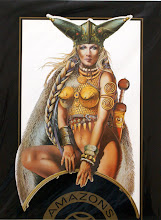
Steve Woron is an American artist best known for his female fantasy art featuring vampires, witches, warriors and mermaids. He was one of the early popularisers of 'good girl art' published through the comics distribution networks. Although they seem to dominate the comics' industry today, the kind of vampires and vixens Woron was drawing were less ubiquitous in the late 1980s. He was one of the first artists to tap into the nostalgia craze for Bettie Page as a pin-up icon in the 1990s, publishing two issues of Betty Page: The 50's Rage in 1993 (reprinted 1996 and 2001).

Steven J. Woron was born in Connecticut on 14 January 1958, the son of Alexander J. Woros and his wife Irene (nee Dabros). He received a BA in Fine Art from the University of Hartford Art School and subsequently taught in High School and privately as well as spending two years as a commercial illustrator as well as 'ghosting' for a famous New York commercial artist.

He attended his first comics' convention in 1978 and launched Spectrum Comics in 1982, producing four comic books, including the 4-issue The Survivors (1983-84) which he both wrote and drew; a year later, he launched The Illustration Studio. From 1984 he was the senior creative artist for a national printing company before turning freelance in 1987, when he began self-publishing prints and portfolios of exotic and erotic fantasy artwork.

He has since gone on to produce trading cards, t-shirts, jackets and other formats. His publications from Illustration Studio include The Art of Steve Woron (1991), The Complete Steve Woron Checklist (1991) and The Steve Woron Treasury (1992) and the comic book format Woron's World (1993-94). As well as illustrations, Woron is also a popular photographer of swimsuit models.

Woron was married Darla Addley, who has also been involved in the comics industry, in 1981 (divorced 1992); he married Laurie Maynard in 1993. He now lives in Vernon, Rockville, Connecticut.

Examples of Steve Woron's artwork can be found for sale at the Illustration Art Gallery.

Wednesday, January 25, 2012

Peter Woolcock

Peter Woolcock has had two careers in art: firstly as a comic strip artist best known for his work in nursery comics; and secondly as a political cartoonist.

Peter Woolcock was born and raised in Argentina, and worked his passage on a cargo boat to England in 1953 in order to find work as an artist. He went from interview to interview and eventually arrived at the doors of the Amalgamated Press, where, he says, he was seen by the wrong man. Five months later he was persuaded to try them again and was immediately offered work by Leonard Matthews.

He created the frog character 'Anthony Rowley' (named after the Frog who went a-wooing), but the name was changed and, as 'The Funny Tales of Freddie Frog' it began appearing in Jack and Jill in 1954. Woolcock was to draw the strip — with a break in the late 1950s/early 1960s — until 1969. This was not his longest-running strip. In 1955, he drew the hugely popular 'The Wind in the Willows' for Playhour which came to an end a year later. Woolcock revived the character of Mr. Toad in Harold Hare's Own Paper in 1959, and continued to draw that character for Harold Hare's Own and Playhour for 25 years. (Woolcock had drawn an earlier, similar character called Toby Toad for Playhour.)

Woolcock was kept incredibly busy for 38 years, his strips and illustrations appearing in Tiny Tots, Film Fun, Look and Learn, Treasure, Disneyland Magazine, Toby, Dickory Dock and Storyland. He retired from drawing strips in 1987.

His books published during the same period include Animal ABC (1980), One, Two, Three: A Book of Numbers by Leonard Matthews (1981), Big and Small: A Book of Opposites by Leonard Matthews (1981), Busy People: A Book of Work and Play by Leonard Matthews (1982), Busy Days: A Book of Time by Leonard Matthews (1982), ABC: A Book of Words (1982) and Rain or Shine: A Book of the Weather (1983).

Woolcock has lived in England, Spain and, since 1981, in Bermuda where, since 1983, he has become one of the island's leading humour and political cartoonists. Some of his early work has been exhibited at the Bermudan National Gallery and many of his cartoons for the Royal Gazette have been collected in the annual Peter Woolcock's Woppened for many years, the 23rd collection appearing in 2011. He has also illustrated children's books, including The Turtle Who Ate a Balloon (2007) and The Adventures of Bermuda's Toad with One Eye (2008).


Examples of Peter Woolcock's artwork can be found for sale at the Illustration Art Gallery.

Wednesday, January 18, 2012

Stanley L. Wood

Stanley L. Wood was a hugely popular contributor to magazines in the late 19th and early 20th centuries, chiefly remembered for his depictions of the wild west which graced many a boy's story paper. It was the perfect match of subject and talent as Wood was superb at depicting horses in action; He spent some of his teen years in Kansas and he returned to America in 1888 when he was sent to South Dakota by The Illustrated London News. An authenticity infused his illustrations — whether a realistic painting or a cartoon — and his colour plates of the wild west in Boy's Own Paper and Chums have helped keep their respective annuals collectable.

Stanley Llewellyn Wood was born in Maindee, near Newport, Monmouthshire, in 1867, the son of Stanley James Wood, a cement manufacturer, and his wife Charlotte (nee Atkins). He grew up in Christchurch, Monmouthshire, and travelled with his family to America at the age of 12, where his father had bought a ranch in Indian territory in Kansas. Legend has it that the bodies of the former owners, who had been murdered by a raiding party of braves, were buried in the garden. Soon after James Stanley Wood’s death, the house was surrounded by Ute Indians and, to scare them away, Charlotte had her children put on riding boots and spurs and they tramped up and down the stairs and from room to room, making as much noise as possible. The ruse worked and, believing the house to be heavily occupied, the natives retreated.

Charlotte and her family returned to St. Pancras, London and Wood went on to become a prolific illustrator of newspapers and magazines, including Black and White, Cassell’s Magazine, The Graphic, The Harmsworth Magazine, The Idler, The London Magazine, The Pall Mall Magazine, Pearson’s Magazine, The Penny Magazine, The Sporting and Dramatic News, The Strand Magazine, Wide World Magazine, The Windsor Magazine and Young England. Wood’s magazine and book illustrations included works by Cutcliffe Hyne (Captain Kettle), Dr. Nokola by Guy Boothby and Don Q. by Hesketh Pritchard. As a painter he also exhibited at the Royal Academy.

Wood married Mary Elizabeth Jenkins in Fulham on 21 February 1899. They had three children: Stanley Montague, Henry Lawrence and Jack Steward. The family lived in Palmers Green, Middlesex, where Wood died on 1 March 1928, aged 61. He had been ill for some weeks and, although he could not raise himself from his bed unaided, insisted that he continue working on his final illustration – for a ‘Kettle’ story – with his wife and son supporting him.

Examples of Stanley L. Wood's artwork can be found at the Illustration Art Gallery.

Wednesday, January 11, 2012

Patrick Woodroffe

Patrick Woodroffe is an artist best known for his often surreal fantasy art.

Patrick James Woodroffe was born in Halifax, West Yorkshire in 1940, the son of an electrical engineer. He graduated in French and German at the University of Leeds before an exhibition of his pen and ink drawings selected by surrealist Roland Renrose was staged at the Institute of Contemporary Arts in London in 1966. He taught before became a full time artist in 1972, in which year he exhibited his paintings and etchings at the Covent Garden Gallery, London.

His career was boosted when he became a paperback cover illustrator, producing some 90 covers for Corgi Books in 1973-76, many of them in the fantasy and science fiction genres, including novels and collections by Ray Bradbury, Arthur C. Clarke, Jack Vance, Mike Moorcock, Frank Herbert, Robert Heinlein and Brian M. Stableford. In the mid-1970s, he also produced record sleeve covers ranging from Beethoven's Emperor Concerto to Judas Priest's Sad Wings of Destiny. His painting for Dave Greenslade's Time and Tide led to further collaborations, Greenslade producing a double album of music, The Pentateuch of the Cosmogony, which was accompanied by a series of paintings by Woodroffe based on the opening chapters of Genesis. The book was expanded as The Second Earth in 1988.

Woodroffe also collaborated with Mike Batt (better known as the leader of the Wombles pop group) on a musical based on Lewis Carroll's The Hunting of the Snark, also released as an album in 1984.

A collection of Woofroffe's paintings, Mythopoeikon, was published by Dragon's World in 1976, which led to him writing and illustrating The Adventures of Tinker the Hole Eating Duck (1976) for the same company. His later books include Hallelujah Anyway (1984), A Closer Look: The Art Techniques of Patrick Woodroffe (1986), The Dorbott of Vacuo (1988), Pastures of the Sky (1993), La Tour du Prisonnier (Switzerland, 2002), The Forget-Me-Not Gardener (Switzerland, 2005) and Benign Icons (Denmark, 2008).

Woodroffe was involved in conceptual deigns for the movie The NeverEnding Story II (1990). He also designed the stage play La Belle et la Bete, performed in Le Havre, France, in 1994, and designed for bronze sculptures that have been cast and installed at the entrance of Le Château de Gruyères in Fribourg, Switzerland.

In the 1990s and 2000s, Woodroffe exhibited widely in France, Switzerland, Germany, Japan and elsewhere. He continues to paint and exhibit, many of his recent works combining fantasy imagery an photographs. Some of his more recent work can be seen in calendars produced by the Swiss publisher, Éditions Gruériennes.


Examples of Patrick Woodroffe's artwork can be found at the Illustration Art Gallery.

Wednesday, January 4, 2012

Edward Woodfall

Edward Woodfall is a mystey artist of whom I can find no trace. The single known piece of artwork is dated 1906, and a check in census records for 1901 reveals only a single person of that name, and he was a 57-year-old domestic servant — a gardener — working in Huyton with Roby, Lancaster.

Three birth records might be relevant: Edward Woodfall, born 1846 in St. Saviour, Southwark; Francis Edward Tidd Woodfall, born 1847 in Thame; and Edward Woodfall, born 1866 in Kensington, London. Of these, the older Edward died in 1869, aged 22; Francis Woodfall became a clerk on the stock exchange; and the younger Edward Woodfall emigrated to America in around 1886 where he worked as a carpenter.

Examples of Edward Woodfall's original artwork can be found at the Illustration Art Gallery.