Wednesday, August 17, 2011
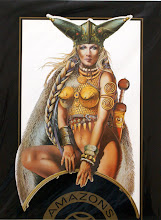
Luis Bermejo
In 1944, Gago created El Guerrero del Antifaz [Warrior of the Mask], which would run for 668 issues, finally ending in 1966. Bermejo began as a letterer on the series in 1947 but, before long, was allowed to ink pages. With Gago’s aid, Bermejo launched his own series in 1948, creating El Rey del Mar [The King of the Sea] for Editorial Valenciana. Written by one of the top scriptwriters of the era, Pedro Quesada, it ran for 46 issues, over which time Bermejo began to assimilate influences other than Gago, notably Alex Raymond.
Bermejo’s comic work diversified. In 1949 he drew “Diablillos” [Mischief] for Chicos and, a couple of years later, “Polín, Poli y Pol-Pol” for the same paper; he drew similarly humorous strips for girls for the woman’s magazine Mariló.
Bermejo returned to Madrid to attend the Academy of Fine Arts at San Fernando, studying under illustrator Carlos Sáenz de Tejada. Bermejo’s schooling meant that a more realistic style and better figurework were on display in over 100 episodes of Aventuras del FBI [Adventures of the FBI], created for Madrid-based Editorial Rollán in 1951, following the successful launch of a series of novels with the title “FBI” a year earlier. The strip, following the adventures of FBI agent Jack Hope, is considered a classic in Spain, ran for years and the episodes drawn by Bermejo were recycled in the 1960s and 1970s, and later available in a complete collection.
Bermejo moved to Valencia and collaborated with a number of top Spanish writers, including Miguel González Casquel (one of the scriptwriters of Aventuras del FBI), with whom he created Sigur (1954) and “Federico Trotamundos” for Chicos (1955) and Pedro Quesada on the juvenile adventure series Roque Brío (1956). The latter was an unexpected failure, lasting on 8 editions, but the two teamed up again for episodes of Pantera Negra [Black Panther], launched in 1956 with artwork by José Ortiz and, later, Miguel Quesada, Manuel Gago’s brother-in-law who had worked with Bermejo in the 1940s.
Bermejo had by now established himself at Editorial Maga, working closely with Gago, Miguel and Pedro Quesada and José and Leopoldo Ortiz. Here he produced his second famous work, Apache, scripted by Pedro Quesada, which he drew for over 50 issues from 1958.
Bermejo was already in demand elsewhere, having produced his first strip for the British market via the agency A.L.I. in 1957—an issue of Super Detective Library featuring private eye Tod Claymore. Bermejo also contributed romance stories to Mirabelle, Romeo and Cherie in 1957-60. At the same time, he was still a busy artist in Spain, working for Bruguera on a series of literary adaptations: “La conquista de los poles”, “Un yanqui en la corte del Rey Arturo” (both published in 1957), “Una vida aventurerea” (1958), “Las aventuras del Club Pickwick” and “Las aventuras de Pinocho” (both 1959).
In 1960, Bermejo began drawing the character John Steel for Super Detective Library. The early stories were fairly commonplace war stories with Steel as a wartime agent for Military Intelligence. But when the stories switched to Thriller Picture Library, Steel was given a make-over and began featuring in a series of jazz-age, crime noir private eye yarns with Bermejo the main artist.
Contributions to War Picture Library, Battle Picture Library, Air Ace and Commando in 1960-62 firmly established Bermejo in the UK and he went on to draw “Mann of Battle” for Eagle (1962) and a series of stories featuring maritime adventurer Pike Mason in Boys’ World (1963-64).
To cope with the workload, Bermejo often worked with Matías Alonso, the main artist on Gago’s “El Guerrero del Antifaz” since 1961, and the two worked on a number of projects for Editorial Maga, including Marco Polo (1963), Vida y costumbres de los Vikingos (1965) and África y sus habitantes (1966). At the same time, Bermejo was having his biggest success in the UK when he worked on “Heros the Spartan” for Eagle, alternating adventures with Frank Bellamy in 1963-66.
Bermejo now had an informal studio set up, working with José Ortiz, Leopoldo Ortiz, Juan González Alacreu, Alfredo Sanchis Cortés and Emilio Frejo, their work agented by Bardon Art in the UK and by Pierro D’Ami in Italy. The Bermejo studio was responsible for many strips in the UK, notably “UFO Agent” in Eagle (1966) and “The Avengers” in Diana (1966-67).
Bermejo, solo, drew “The Missing Link” for Fantastic in 1967-68 and contributed illustrations to Tell Me Why, Look and Learn and Once Upon a Time, also painting the long-running fairy tale Princess Marigold for Treasure (1969-71).
Bermejo was a popular contributor to James Warren's horror magazines Vampirella, Creepy and Eerie in 1975-79, notably drawing "The Rook". In 1979-81, he drew an adaptation of Lord of the Rings which was published throughout Europe. He subsequently produced episodes of Storia Del West, drew "The Fox" for Vampirella and other for Warren. The recovering Spanish market also meant regular work in Cimoc, Metropol, Baladin, Hunter, Zona 84 and other magazines, as well as adapting books by Isaac Asimov and A. E. Van Vogt.
He worked on the revival of the famous adventure strip "El Capitán Trueno" [Captain Thunder] in 1986, but turned to painting and was able to retire from comics in the early 1990s.
Examples of artwork by Luis Bermejo can be found for sale at the Illustration Art Gallery.
Wednesday, August 10, 2011
Wednesday, August 3, 2011
David Bergen
Bergen then seemed to disappear until 1990 when his work began appearing on various Pan fantasy and SF titles as well as the Puffin editions of Ursula Le Guin's Earthsea series. He continued to produce covers until at least 1997 when his work again disappears from sight.
What other areas he was (presumably) active in I have no idea; perhaps the lack of credits in the 1980s is literally down to the lack of credits that appeared on books. There can be no doubt as to the quality of his work and he was twice nominated (1991, 1992) for the World Fantasy Award.
Personal information on the artist is almost zero. I believe he was born in Newcastle-upon-Tyne in 1947 but a search of the internet turns up nothing else (and any search is rather confused thanks to there being a Canadian author (born 1957) of the same name).
Examples of David Bergen's artwork can be found for sale at the Illustration Art Gallery.
Wednesday, July 27, 2011
James Bama
If one theme can be seen through Bama's work it might be described as "one man (or woman) in the wilderness", as his covers often featured isolated single figures, some alone against expansive backgrounds; it is a style that can be seen in such diverse Bama illustrations as Freedom Road by Howard Fast and Groupie by Johnny Byrne & Jenny Fabian (both Bantam) and Dell's edition of Desmond Morris's The Naked Ape. It is also a theme that has extended into his fine art work where Bama, using photographs of real mountain men and Native Americans as reference, often isolates the figures to create portraits where wheathered facial features, clothing and body language tell a story. In other paintings, landscapes and animals add location to Bama's evocation of the rugged modern day prairie men.
James E. Bama was born in Manhattan on 28 April 1926, the second son of Benjamin Bama, a Russian-born apron salesman, and his wife Selma, also the daughter of Russian immigrants. Raised in New York City, Bama was inspired to draw by the adventure strips of the time, most notably Alex Raymond's Flash Gordon, Burne Hogarth's Tarzan and Frank Miller's Barney Baxter. His father died of a stroke when Bama was 13, and his mother suffered a debilitating stroke the following year; Bama had to cook and clean and began earning money, making his first $50 sale, a drawing of Yankee Stadium, to The Sporting News at the age of 15.
He graduated from the High School of Music and Art and enlisted in the U.S. Army Air Corps' Eastern Flying Training Command unit in 1944, where he worked as a mechanic and physical training instructor, as well as painting murals. On his discharge, he used the GI Bill to enrol at the Art Students League, where he was learned drawing and anatomy under Frank J. Reilly.
After freelancing briefly - his first sales including Western paperback covers A Bullet for Billy the Kid by Nelson C. Nye (Avon, 1950) and Dead Sure by Stewart Sterling (Dell, 1950) - he began working for one of New York's leading illustration firms, Charles E. Cooper Studios, in 1951. for the next fifteen years, he produced commercial artwork for a range of clients, including the Baseball Hall of Fame, the New York Giants and the U.S. Air Force.
However, it is for his paperback covers that he became known, especially the 62 covers he painted for Bantam Books' reprints of Doc Savage pulp magazine stories. Clark Savage Jr had been the star of 181 full-length adventures in the pages of Doc Savage Magazine (1933-49), 159 of them written by prolific pulpster Lester Dent. The heroic adventurer and scientist had been trained to almost superhuman physical and mental ability and faced a range of supernatural and superscientific foes. Bama was introduced to the saga when Bantam Books began reprinting the series in 1964 with The Man Of Bronze, Doc's debut adventure.
Bama gave Doc a buzz cut, replacing the kiss-curl of his pulp days, and beefed him up, using Steve Holland, a muscular fashion model who had starred in the Flash Gordon TV series in 1954-55, as the basis for his vision of Doc Savage. The books sold incredibly well and all 182 stories were reprinted between 1964 and 1990.
Although much of his early work was Western covers for the likes of Louis L'Amour and Zane Grey, Bama quickly expanded his cover art repertoire to include everything from contemporary novels, thrillers, romances and non-fiction. A small sampling of his work would include A Rage at Sea by Frederick Lorenz (Lion, 1957), Requiem for a Gun by Burt & Budd Arthur (Avon, 1963), The Pillars of Midnight by Elleston Trevor (Ballantine, 1963), President's Agent by Joseph Hilton (Lancer, 1963), Colette Cheri (Berkley, 1966) and covers depicting James Bond and the characters from Star Trek.
As well as Doc Savage, Bama painted many other covers for Bantam, including King Kong by Delos W. Lovelace (1965) and Frankenstein by Mary Shelley (1967). Bama had an affinity for classic horror characters, having been a childhood horror movie fan; in the early 1960s, beginning with Frankenstein, he produced vivid box artwork for a series of model kits based on Universal's movie monsters; Dracula, Wolf Man, The Mummy and others followed as well as Aurora's Monster Hot Rods and Monster Customizing Kits.
Bama then changed tack after first visiting Wyoming in 1966; he and his wife, Lynn, a photographer whom he met in 1963, moved permanently to Cody, Wyoming, in 1968. During this period he transited from illustration to making more personal works, often inspired by his new surroundings. Much of his work was of contemporary Western and Native American subjects; wildlife and mountain men feature against stunning Wyoming backdrops.
Bama is inspired by real inhabitants of the state, visiting reservations and meeting trappers and cowboys; his prices rapidly escalated and, within three years, he was making far more than he had as an illustrator.He also sought inspiration in travel, to China, Mexico, Tibet and Turkey.
Bama was the recipient of the Spectrum Grand Master Award in 1998 and was inducted into the Society of Illustrators Hall of Fame in June 2000. His work is to be found in the collections of Clint Eastwood, Nicholas Cage and Malcolm Forbes as well as numerous galleries.
Bama, who has lived in Wapati, Wyoming, since 1971, remains a keen on physical training, regularly doing heavy exercise even in his eighties. He is a keen reader and movie viewer.
Bibliography
The Western Art of James Bama, with an introduction by Ian Ballantine (Scribner, 1975; enlarged, Bantam, 1980)
James Bama: A Wyoming Realist by Warren Adelson (Coe Kerr Gallery, 1985)
The Art of James Bama by Elmer Kelton (Greenwich Workshop, 1993)
James Bama: American Realist, edited by Brian M. Kane, with an introduction by Harlan Ellison (Flesk Publications, 2006)
James Bama Sketchboo: A Seventy-Year Journey, Travelling from the Far East to the Wild West , edited by John Fleskes (Flesk Publications, 2010)
Original prints by James Bama can be found for sale at the Illustration Art Gallery.
Wednesday, July 20, 2011
Giorgio De Gaspari
De Gaspari was born on 30 January 1927, possibly in Varese - or the province of Varese - north of Milan in north-western Italy, not far from the Swiss border. He began his career under the auspices of comic strip artist and illustrator Walter Molino who, in the 1940s, was a leading contributor to Grand Hotel, to which paper De Gaspari also contributed; another strip ('Uragano, il re della prateria' [Hurricane, the King of the Prairie]) appeared in Success Collection published by CEA in 1946-47. De Gaspari also worked for Il Giornalino di Carroccio and illustrated 'il Giustiziere scarlatto' for Albi Mignon.
In May 1947 his first illustrations appeared in La Domenica del Corriere, a Sunday paper which he was to continue contributing to until February 1970, producing over 1,000 illustrations. De Gaspari's paintings were of high quality and innovative in their use of original material, tools and techniques. He would use any sort of paper, create collages and cut and scratch the images. This experimentation with his artwork did occasionally cause him to fall foul of his editors. In one instance, on a Kit Carson cover painting for Cowboy Picture Library, he used real sand glued onto the page; although it made for a superb, textured image, it all had to be scraped off and a new sandy background painted in by an in-house 'bodger' rather than run the risk of damaging the machinery that turned the artwork into four-colour separations.
De Gaspari was a busy chidlren's book illustrator in Italy for publishers Valladri, Agostoni, Lucchi and Fabbri as well as contributing illustrations to Arianna. Amongst the many titles he illustrated in the 1940s and 1950s were editions of Pinocchio, Don Quixote, The Three Musketeers, Moby Dick, 20,000 Leagues Under the Sea and various fairy tale books.
Examples of De Gaspari's artwork can be found for sale at the Illustration Art Gallery.
Wednesday, July 13, 2011
Leslie Bowyer
He also produced advertising designs and watercolours and contributed to Children's Own Wonder Book (1947).
Wednesday, July 6, 2011
George Bowe
George Bowe is a bit of a mystery. His career began at least as early as 1948 when he illustrated two books by Enid Blyton and continued until at least 1974 when he drew 'At the End of the Rainbow' in Bonnie.In between he contributed illustrations to Boy's Own Paper, Pony Club Annual, Robin Annual, Girl Annual and Swift Annual in the 1950s and 1960s.
For an artist with a career spanning at least 26 years, it is surprising that nothing else is known.
George Bowe artwork for sale at The Illustration Art Gallery.
Illustrations
Let's Have a Story by Enid Blyton. London, H. A. & W. Pitkin, 1948.
We Want a Story by Enid Blyton. London, H. A. & W. Pitkin, 1948.
The Bard's Cloak by Percy G. Griggs. London, H. A. & W. Pitkin, 1950.
Tiger Hawk by George E. Rochester. London, H. A. & W. Pitkin, 1956.
Ten-Week Stables by Sylvia Scott White. London, Lutterworth Press, 1960.