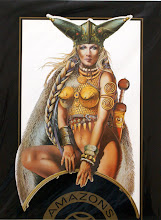
Charlie Adlard has been discovered and rediscovered a number of times in both the UK and US. After producing a string of short-lived strips beginning with 'Biggles Bear' in 1989, Adlard approached Steve MacManus with samples and was offered a Judge Dredd strip. He then drew various strips for the Judge Dredd Megazine, notably 'Armitage', about a brutal Brit-Cit cop and his partner, Treasure Steel (who subsequently featured in her own series), and for Marvel UK, where his best work was probably Dances With Demons, a 4-issue mini-series penned by Simon Jowett; a second collaboration with Jowett, entiteld 'Bloodrush', went unpublished.
By this time, Adlard had been discovered by American publishers, drawing stories for Black Orchid Annual, Marvel Comics Presents and Good Guys. After producing a five-issue run of Mars Attacks! for Topps, Adlard began working on the best-selling X-Files comic strip from the same publisher. The strip was a tremendous success and was still selling an average 130,000 copies per issue when Adlard decided to leave, claiming that the strip was straight-jacketed by the demands of the company and he had little artistic control.
He left to work on Shadowman for Acclaim and, although never short of relatively high-profile work (on, for instance, The Crow, Gen13, Superman and X-Men, it might be said that Adlard was critically discovered only when he began working on Larry Young's Astronauts in Trouble in 1999.
In the 2000s, Adlard was, again, kept busy on a range of titles, including Blair Witch: Dark Testaments and Double Image for Image; The Authority and The Establishment for WildStorm, Before the Fantastic Four, X-Men Unlimited, Peter Parker: Spider-Man, ThunderBolts and Warlock for Marvel and Batman/Scarface: A Psychodrama, Green Arrow, Green Lantern, Harley Quinn and Batman: Gotham Knights for DC.
However, it was with The Walking Dead for Image that Adlard was yet again rediscovered in 2004. Adlard replaced original artist Tony Moore with issue 7 (April 2004) and has continued the series ever since, the series now approaching issue 90 at the time of writing. The post-zombie apocalypse storyline proved very popular with readers and rode a wave of zombie popularity in movies (28 Days Later and Resident Evil had both appeared in 2002). Countless zombie comics - most notably the Marvel Zombies sequence and spin-offs - have subsequently appeared but few have been as critically well-received as The Walking Dead, which won the Eisner Award for Best Continuing Series in 2010. A 6-part television series based on the comic developed by Frank Darabont, began broadcasting in October 2010; a second series of 13-episodes was commissioned within days of the show's debut.
As well as his work in America, Adlard has retained his connections with the UK, drawing the graphic novel Playing the Game by Doris Lessing in 1995 and episodes of 'Nikolai Dante' for 2000AD in the late 1990s. However, it was the relaunch of Pat Mills' 'Savage' in 2004 that brought Adlard back to the attention of fans of British comics. He went on to draw three series of the character's revival between 2004 and 2007.
Adlard has also played drums with various bands over the years (Wild Thyme, Bogus Monk, Mine Power Cosmic).
Examples of Charlie Adlard's original artwork can be found for sale at the Illustration Art Gallery.
Wednesday, September 28, 2011
Wednesday, September 21, 2011
Brian Lewis
Brian Lewis is an artist whose reputation has continued to endure long after his death. Known in science fiction circles for his often abstract covers for New Worlds, Science Fantasy and Science Fiction Adventures and in comic circles for his contributions to House of Hammer, appreciation of Lewis's work has grown as more of his work for other papers and magazines is discovered.
Brian Moncreif Lewis was born on 3 June 1929 and served his National Service with the RAF. An interest in science fiction led him to co-edit and contribute to The Medway Journal fanzine in the early 1950s. His first professional sale relating to SF is thought to be an illustration relating to 'Journey Into Space' for the Radio Times. His connections with Nova Publications began in 1954 and, between 1957 and 1962 he painted some 80 covers for their three SF magazines, his work often showing a strong surrealist influence. During the same period he also painted a number of rather more straight-forward covers for Digit Books.
Lewis made his comic strip debut in 1959, drawing early strips for Lone Star and TV Comic. However, it was with 'Jet Ace Logan' in Tiger that he found his feet and there followed a 13-month run on 'Captain Condor' in 1961-63. Lewis also proved adept at drawing sports and war strips, culminating in work for Eagle where he drew 'Mann of Battle' and 'Home of the Wanderers'. Science fiction was not forgotten and Lewis drew SF tales for Boys' World, Tiger and Hurricane.In 1964 he also proved himself as a humour artist when he began contributing cartoon strips to Wham! and, over the next few years, humour and adventure strips often ran concurrently in the pages of Smash!.
In the late 1960s, Lewis worked for the Central Office of Information on public information films and also contributed to the Beatles' animated movie Yellow Submarine. He suffered a heart attack in 1970 and struggled for some years, drawing strips for Countdown and Look-In and a series of scientific biographies for All About Science. In 1976, his agent contacted Dez Skinn suggesting Lewis as an artist for the upcoming House of Hammer; Skinn was only persuaded after seeing samples, but the connection proved fruitful, eventually leading to a brief association between Lewis and 2000AD where he drew covers and, briefly, the 'Dan Dare' strip.
A busy artist in the late 1970s, painting books covers and contributing to The Muppet Show Diary, annuals, Vampirella and Target magazine, Lewis suffered a heart attack and died on 4 December 1978, aged only 49.
Examples of Brian Lewis's artwork can be found for sale at the Illustration Art Gallery.
Brian Moncreif Lewis was born on 3 June 1929 and served his National Service with the RAF. An interest in science fiction led him to co-edit and contribute to The Medway Journal fanzine in the early 1950s. His first professional sale relating to SF is thought to be an illustration relating to 'Journey Into Space' for the Radio Times. His connections with Nova Publications began in 1954 and, between 1957 and 1962 he painted some 80 covers for their three SF magazines, his work often showing a strong surrealist influence. During the same period he also painted a number of rather more straight-forward covers for Digit Books.
Lewis made his comic strip debut in 1959, drawing early strips for Lone Star and TV Comic. However, it was with 'Jet Ace Logan' in Tiger that he found his feet and there followed a 13-month run on 'Captain Condor' in 1961-63. Lewis also proved adept at drawing sports and war strips, culminating in work for Eagle where he drew 'Mann of Battle' and 'Home of the Wanderers'. Science fiction was not forgotten and Lewis drew SF tales for Boys' World, Tiger and Hurricane.In 1964 he also proved himself as a humour artist when he began contributing cartoon strips to Wham! and, over the next few years, humour and adventure strips often ran concurrently in the pages of Smash!.
In the late 1960s, Lewis worked for the Central Office of Information on public information films and also contributed to the Beatles' animated movie Yellow Submarine. He suffered a heart attack in 1970 and struggled for some years, drawing strips for Countdown and Look-In and a series of scientific biographies for All About Science. In 1976, his agent contacted Dez Skinn suggesting Lewis as an artist for the upcoming House of Hammer; Skinn was only persuaded after seeing samples, but the connection proved fruitful, eventually leading to a brief association between Lewis and 2000AD where he drew covers and, briefly, the 'Dan Dare' strip.
A busy artist in the late 1970s, painting books covers and contributing to The Muppet Show Diary, annuals, Vampirella and Target magazine, Lewis suffered a heart attack and died on 4 December 1978, aged only 49.
Examples of Brian Lewis's artwork can be found for sale at the Illustration Art Gallery.
Wednesday, September 14, 2011
John Bolton
John Bolton is best known for his painted comic strips, his dark, photorealist style particularly effective on horror stories, in which genre he became somewhat typecast through his work on adaptations of Clive Barker and Sam Raimi's film Army of Darkness and his series of voluptuous she-vampire paintings. Bolton's work in the broader field of fantasy is probably best exemplified by his collaborations with Chris Claremont, which included Marada the She Wolf in Epic Illustrated and the 6-issue mini-series The Black Dragon.
Born in London, 23 May 1951, Bolton trained as civil engineer, then worked as a clothes salesman in London. Inspired by a childlhood love of drawing and painting, he took a 3-year course at East Ham Technical College, graduating with a degree in graphics and design. His first professional sales were made in 1971 when he contributed illustrations to a book on horses.
His first comics-related work came via Granddreams, illustrating annuals such as The Magician, The Lone Ranger, Planet of the Apes, Flash Gordon, New Avengers and Tarzan. His first strips appeared in House of Hammer in 1976, including adaptations of 'Dracula, Prince of Darkness' and 'One Million Years B.C.', and early episodes of the Steve Moore-written 'Father Shandor' series. Switching to colour, he made an immediate impact drawing 'The Bionic Woman' for Look-In. Bolton won the Eagle Award for Favourite Comicbook Artist (UK) in 1979.
His American debut came with 'Kull', written by Doug Moench for Marvel Preview in 1980. A year later, his first painted strips - 'The Llehs' - appeared in Epic Illustrated followed in 1982 by 'Marada the She-Wolf'. Dozens of short horror tales appeared in Twisted Tales, Alien Worlds, Pathways to Fantasy, Tales of Terror, Alien Encounters and Cheval Noir over the next few years, as did The Black Dragon. Bolton could also turn his hand to mainstream comicbooks, which he did with a run of back-up stories in Classic X-Men in 1986-89 and Wonder Woman Annual (1988).
Graphic novels like Someplace Strange (1988), written by Ann Nocenti, and The Yattering and Jack (1992), adapted from a Clive Barker story by Steve Niles, and his painting of the first issue of The Books of Magic by Neil Gaiman helped cement his reputation as Britain's finest weird-fantasy/horror artist. He has since gone on to work on many other titles, chief amongst them Man-Bat (1995), written by Jamie Delano, Menz Insana (1997) by Christopher Fowler, Gifts of the Night (1999) by Paul Chadwick, Batman/Joker: Switch (2003) by Devin Grayson, God Save the Queen (2007) by Mike Carey, The Evil Dead (2008) by Mark Verheiden and The Green Woman (2010) by Peter Straub & Michael Easton.
Over the years, Bolton has also published portfolios, illustrated trading cards and worked as a storyboard and concept artist.
A Short Film About John Bolton (2003) was written and directed by Neil Gaiman, although it featured a fictional version of Bolton's life. Bolton is played by John O'Mahony, with Marcus Brigstocke playing an interviewer who discovers, to his cost, what inspires Bolton's disturbing art. Bolton himself had a cameo in the film.
His latest work is Shame: Conception for Renegade Arts Entertainment, released in July 2011; at the time of writing he is working on the second book in a proposed trilogy.
Examples of John Bolton's artwork can be found for sale at the Illustration Art Gallery.
Born in London, 23 May 1951, Bolton trained as civil engineer, then worked as a clothes salesman in London. Inspired by a childlhood love of drawing and painting, he took a 3-year course at East Ham Technical College, graduating with a degree in graphics and design. His first professional sales were made in 1971 when he contributed illustrations to a book on horses.
His first comics-related work came via Granddreams, illustrating annuals such as The Magician, The Lone Ranger, Planet of the Apes, Flash Gordon, New Avengers and Tarzan. His first strips appeared in House of Hammer in 1976, including adaptations of 'Dracula, Prince of Darkness' and 'One Million Years B.C.', and early episodes of the Steve Moore-written 'Father Shandor' series. Switching to colour, he made an immediate impact drawing 'The Bionic Woman' for Look-In. Bolton won the Eagle Award for Favourite Comicbook Artist (UK) in 1979.
His American debut came with 'Kull', written by Doug Moench for Marvel Preview in 1980. A year later, his first painted strips - 'The Llehs' - appeared in Epic Illustrated followed in 1982 by 'Marada the She-Wolf'. Dozens of short horror tales appeared in Twisted Tales, Alien Worlds, Pathways to Fantasy, Tales of Terror, Alien Encounters and Cheval Noir over the next few years, as did The Black Dragon. Bolton could also turn his hand to mainstream comicbooks, which he did with a run of back-up stories in Classic X-Men in 1986-89 and Wonder Woman Annual (1988).
Graphic novels like Someplace Strange (1988), written by Ann Nocenti, and The Yattering and Jack (1992), adapted from a Clive Barker story by Steve Niles, and his painting of the first issue of The Books of Magic by Neil Gaiman helped cement his reputation as Britain's finest weird-fantasy/horror artist. He has since gone on to work on many other titles, chief amongst them Man-Bat (1995), written by Jamie Delano, Menz Insana (1997) by Christopher Fowler, Gifts of the Night (1999) by Paul Chadwick, Batman/Joker: Switch (2003) by Devin Grayson, God Save the Queen (2007) by Mike Carey, The Evil Dead (2008) by Mark Verheiden and The Green Woman (2010) by Peter Straub & Michael Easton.
Over the years, Bolton has also published portfolios, illustrated trading cards and worked as a storyboard and concept artist.
A Short Film About John Bolton (2003) was written and directed by Neil Gaiman, although it featured a fictional version of Bolton's life. Bolton is played by John O'Mahony, with Marcus Brigstocke playing an interviewer who discovers, to his cost, what inspires Bolton's disturbing art. Bolton himself had a cameo in the film.
His latest work is Shame: Conception for Renegade Arts Entertainment, released in July 2011; at the time of writing he is working on the second book in a proposed trilogy.
Examples of John Bolton's artwork can be found for sale at the Illustration Art Gallery.
Wednesday, September 7, 2011
Kenneth Lilly
Kenneth Norman Lilly was one of the finest of British nature artists, his drawings of wildlife - most notably the kind of wildlife you would find in your hedgerow or nearby fields - drawn with a passion and interest for the subject.
Born in Bromley, Surrey, on 30 December 1929, the son of Cecil Lilly and his wife Raibie (nee Mayes), Lilly became a prolific contributor of illustrations and covers to Look and Learn and Treasure. He produced a number of notable series for the former, illustrating Maxwell Knight’s ‘This Month in the Country’ (1967) and Ken Denham’s series on ‘Animal Families’ (1968).
Lilly was also a regular illustrator of books from the 1970s onwards and an exhibition of his animal paintings was held at the Medici Galleries in London in 1983. Some of the best illustrations can be found in Kenneth Lilly’s Animals (1988). As well as books, Lilly also illustrated a set of stamps entitled ‘Friends of the Earth’, released in 1986.
In 1992, Dorling Kindersley published a series of short children's books under the title Kenneth Lilly's Animal Ark, which grouped animals with common features (feathers, scales, spots or stripes) with a single sentence description by Angela Wilkes. A later series by Tessa Potter featured different animals and different seasons. One of his most notable series was a number of books which depicted animals at life size.
Lilly, who lived in Devon, died in the spring of 1996, aged 66.
Examples of Kenneth Lilly's work can be found for sale at the Illustration Art Gallery.
Books illustrated by Kenneth Lilly
Seabirds by David Saunders. London, Hamlyn, 1971; some illustration reused in The Seashore by Jennifer Cochrane; illus. with others. Feltham, Hamlyn, 1973.
The Scandaroon by Henry Williamson. London, Macdonald & Co., 1972.
Birds of Prey by Glenys and Derek Lord. London, Hamlyn, 1979.
Some Birds and Mammals of the Field and Hedgerow. London, Medici Society, 1980.
The Squirrel by Margaret Lane. London, Methuen/Walker, 1981.
Animals at the Zoo. London, Methuen, 1982.
Animals in the Country. London, Methuen, 1982.
Animals in the Jungle. London, Methuen, 1982.
Animals of the Ocean. London, Methuen, 1982.
Animals on the Farm. London, Methuen, 1982.The Fox by Margaret Lane. London, Methuen, 1982.
Some Birds and Mammals of the Riverbank. London, The Medici Society, 1983.
Animal Builders. London, Walker, 1984
Arnimal Climbers. London, Walker, 1984.
Animal Jumpers. London, Walker, 1984.
Animal Runners. London, Walker, 1984.
Animal Swimmers. London, Walker, 1984.
Daytime Animals by Joanna Cole. London, Walker, 1985.
Nighttime Animals by Joanna Cole. London, Walker, 1985.
Come, Come to My Corner by William Mayne. London, Walker, 1986.
Kenneth Lilly's Animals by Joyce Pope. London, Walker, 1988.
Large as Life Animals by Joanna Cole. London, Walker, 1990.
The Animal Atlas by Barbara Taylor. London, Dorling Kindersley, 1992.
Colourful Animals by Angela Wilkes. London, Dorling Kindersley, 1992.
Feathery Animals by Angela Wilkes. London, Dorling Kindersley, 1992.
Furry Animals by Angela Wilkes. London, Dorling Kindersley, 1992.
Prickly Animals by Angela Wilkes. London, Dorling Kindersley, 1992.
Scaly Animals by Angela Wilkes. London, Dorling Kindersley, 1992.
Spotty Animals by Angela Wilkes. London, Dorling Kindersley, 1992.
Stripey Animals by Angela Wilkes. London, Dorling Kindersley, 1992.
Wrinkly Animals by Angela Wilkes. London, Dorling Kindersley, 1992.
A Field Full of Horses by Peter Hansard. London, Walker, 1993; with additional CD, Walker, 2010.
Baby Animals by Kate Hayden. London, Walker, 1996.
Digger: The Story of a Mole by Tessa Potter. London, Andersen, 1996.
Fang: The Story of a Fox by Tessa Potter. London, Andersen, 1996.
Greyfur: The Story of a Rabbit by Tessa Potter. London, Andersen, 1996.
Sarn: The Story of an Otter by Tessa Potter. London, Andersen, 1996.
The Big Book of Animals by Sheila Hanly. London, Dorling Kindersley, 1997.
My Little Animals Board Book. London, Dorling Kindersley, 1998.
My First Animal Board Book. London, Dorling Kindersley, 1999.
My First Animal Book. London, Dorling Kindersley, 2002.
Born in Bromley, Surrey, on 30 December 1929, the son of Cecil Lilly and his wife Raibie (nee Mayes), Lilly became a prolific contributor of illustrations and covers to Look and Learn and Treasure. He produced a number of notable series for the former, illustrating Maxwell Knight’s ‘This Month in the Country’ (1967) and Ken Denham’s series on ‘Animal Families’ (1968).
Lilly was also a regular illustrator of books from the 1970s onwards and an exhibition of his animal paintings was held at the Medici Galleries in London in 1983. Some of the best illustrations can be found in Kenneth Lilly’s Animals (1988). As well as books, Lilly also illustrated a set of stamps entitled ‘Friends of the Earth’, released in 1986.
In 1992, Dorling Kindersley published a series of short children's books under the title Kenneth Lilly's Animal Ark, which grouped animals with common features (feathers, scales, spots or stripes) with a single sentence description by Angela Wilkes. A later series by Tessa Potter featured different animals and different seasons. One of his most notable series was a number of books which depicted animals at life size.
Lilly, who lived in Devon, died in the spring of 1996, aged 66.
Examples of Kenneth Lilly's work can be found for sale at the Illustration Art Gallery.
Books illustrated by Kenneth Lilly
Seabirds by David Saunders. London, Hamlyn, 1971; some illustration reused in The Seashore by Jennifer Cochrane; illus. with others. Feltham, Hamlyn, 1973.
The Scandaroon by Henry Williamson. London, Macdonald & Co., 1972.
Birds of Prey by Glenys and Derek Lord. London, Hamlyn, 1979.
Some Birds and Mammals of the Field and Hedgerow. London, Medici Society, 1980.
The Squirrel by Margaret Lane. London, Methuen/Walker, 1981.
Animals at the Zoo. London, Methuen, 1982.
Animals in the Country. London, Methuen, 1982.
Animals in the Jungle. London, Methuen, 1982.
Animals of the Ocean. London, Methuen, 1982.
Animals on the Farm. London, Methuen, 1982.The Fox by Margaret Lane. London, Methuen, 1982.
Some Birds and Mammals of the Riverbank. London, The Medici Society, 1983.
Animal Builders. London, Walker, 1984
Arnimal Climbers. London, Walker, 1984.
Animal Jumpers. London, Walker, 1984.
Animal Runners. London, Walker, 1984.
Animal Swimmers. London, Walker, 1984.
Daytime Animals by Joanna Cole. London, Walker, 1985.
Nighttime Animals by Joanna Cole. London, Walker, 1985.
Come, Come to My Corner by William Mayne. London, Walker, 1986.
Kenneth Lilly's Animals by Joyce Pope. London, Walker, 1988.
Large as Life Animals by Joanna Cole. London, Walker, 1990.
The Animal Atlas by Barbara Taylor. London, Dorling Kindersley, 1992.
Colourful Animals by Angela Wilkes. London, Dorling Kindersley, 1992.
Feathery Animals by Angela Wilkes. London, Dorling Kindersley, 1992.
Furry Animals by Angela Wilkes. London, Dorling Kindersley, 1992.
Prickly Animals by Angela Wilkes. London, Dorling Kindersley, 1992.
Scaly Animals by Angela Wilkes. London, Dorling Kindersley, 1992.
Spotty Animals by Angela Wilkes. London, Dorling Kindersley, 1992.
Stripey Animals by Angela Wilkes. London, Dorling Kindersley, 1992.
Wrinkly Animals by Angela Wilkes. London, Dorling Kindersley, 1992.
A Field Full of Horses by Peter Hansard. London, Walker, 1993; with additional CD, Walker, 2010.
Baby Animals by Kate Hayden. London, Walker, 1996.
Digger: The Story of a Mole by Tessa Potter. London, Andersen, 1996.
Fang: The Story of a Fox by Tessa Potter. London, Andersen, 1996.
Greyfur: The Story of a Rabbit by Tessa Potter. London, Andersen, 1996.
Sarn: The Story of an Otter by Tessa Potter. London, Andersen, 1996.
The Big Book of Animals by Sheila Hanly. London, Dorling Kindersley, 1997.
My Little Animals Board Book. London, Dorling Kindersley, 1998.
My First Animal Board Book. London, Dorling Kindersley, 1999.
My First Animal Book. London, Dorling Kindersley, 2002.
Wednesday, August 31, 2011
Barrie Linklater
Born in Birmingham, Warwickshire, in 1931, Barrie Linklater studied at Woolwich Polytechnic School of Art and began his artistic career working in a London studio before leaving for Australia where he worked as a freelance for four years.
Returning to London, Linklater forged a reputation as a fine portrait artist and subsequently as an equestrian artist, his first commission in the latter area coming from HRH the Duke of Edinburgh during a sitting for a portrait in 1975. Equestrian work has since been commissioned by Her Majesty The Queen and the City of London amongst many others. In all he has 13 paintings in the Royal Collection and his work has been exhibited at the National Portrait Gallery. Linklater lives and works in Berkshire.
In the 1960s, Linklater contributed illustrations to Look and Learn's adaptation of H. G. Wells' 'The First Men in the Moon' in 1963 and later, in 1967, began producing covers and illustrations on a semi-regular basis.
Examples of Barrie Linklater's artwork can be found for sale at the Illustration Art Gallery.
Returning to London, Linklater forged a reputation as a fine portrait artist and subsequently as an equestrian artist, his first commission in the latter area coming from HRH the Duke of Edinburgh during a sitting for a portrait in 1975. Equestrian work has since been commissioned by Her Majesty The Queen and the City of London amongst many others. In all he has 13 paintings in the Royal Collection and his work has been exhibited at the National Portrait Gallery. Linklater lives and works in Berkshire.
In the 1960s, Linklater contributed illustrations to Look and Learn's adaptation of H. G. Wells' 'The First Men in the Moon' in 1963 and later, in 1967, began producing covers and illustrations on a semi-regular basis.
Examples of Barrie Linklater's artwork can be found for sale at the Illustration Art Gallery.
Wednesday, August 24, 2011
Vince Locke
Vince Locke is an American artist, often associated with grotesque and violent fantasy and horror images, although his work has also included mainstream superhero work for Batman and The Spectre, as well as work for British comics 2000AD and Judge Dredd Megazine.
Born in Michigan in 1966, the son of a sign painter. Influenced by artists like Andrew Wyeth and turn of the century illustrators, Locke came to fan attention with his work on Deadworld, a zombie horror series created by Stuart Kerr and Ralph Griffith for their own small press outfit Arrow Comics. Deadworld, by Kerr and Locke, was launched in 1987 but lasted only seven issues before the collapse of the black & white market in the US. Deadworld was continued by Caliber Comics and Locke continued drawing the series until 1991 as well as inking Baker Street in 1989-91.
Locke found work with Vertigo, drawing or inking episodes of The Sandman (1992-93), American Freak: A Tale of the Un-Men (1994), Sandman Mystery Theatre (1994-95), Witchcraft: La Terreur (1998) and The Books of Faerie: Auberon's Tale (1998). For Paradox Press Locke drew A History of Violence (1997) written by John Wagner, which was filmed by David Cronenberg in 2005 with Viggo Mortensen in the lead role.
The artist has also been long associated with the death metal band Cannibal Corpse. He has painted covers for all their albums starting with Eaten Back to Life in 1989. The ultraviolent images - ranging from zombie doctors to visceral birth scenes. Locke also illustrated the graphic novel Evisceration Plague which was distributed during the band's tour promoting the album of that name and featured stories based on each of the songs.
In the early 2000s, Locke was a popular contributor to White Wolf and Wizards of the Coast, producing many illustrations for the latter's Forgotten Realms role-playing games.In 2006-09, Locke drew a number of 'Tales from the Black Museum' one-off stories for Judge Dredd Megazine, a 'Tharg's Future Shocks' and two Judge Dredd yarns for 2000AD. He has also drawn illustrations for two collections of stories by Caitlin R. Kiernan, Frog Toes and Tentacles (2005), Tales from the Woeful Platypus (2007) and A is for Alien (2009).
Locke, married and with three children, lives in the suburbs of Michigan.
Examples of Vince Locke's artwork can be found for sale at the Illustration Art Gallery.
Born in Michigan in 1966, the son of a sign painter. Influenced by artists like Andrew Wyeth and turn of the century illustrators, Locke came to fan attention with his work on Deadworld, a zombie horror series created by Stuart Kerr and Ralph Griffith for their own small press outfit Arrow Comics. Deadworld, by Kerr and Locke, was launched in 1987 but lasted only seven issues before the collapse of the black & white market in the US. Deadworld was continued by Caliber Comics and Locke continued drawing the series until 1991 as well as inking Baker Street in 1989-91.
Locke found work with Vertigo, drawing or inking episodes of The Sandman (1992-93), American Freak: A Tale of the Un-Men (1994), Sandman Mystery Theatre (1994-95), Witchcraft: La Terreur (1998) and The Books of Faerie: Auberon's Tale (1998). For Paradox Press Locke drew A History of Violence (1997) written by John Wagner, which was filmed by David Cronenberg in 2005 with Viggo Mortensen in the lead role.
The artist has also been long associated with the death metal band Cannibal Corpse. He has painted covers for all their albums starting with Eaten Back to Life in 1989. The ultraviolent images - ranging from zombie doctors to visceral birth scenes. Locke also illustrated the graphic novel Evisceration Plague which was distributed during the band's tour promoting the album of that name and featured stories based on each of the songs.
In the early 2000s, Locke was a popular contributor to White Wolf and Wizards of the Coast, producing many illustrations for the latter's Forgotten Realms role-playing games.In 2006-09, Locke drew a number of 'Tales from the Black Museum' one-off stories for Judge Dredd Megazine, a 'Tharg's Future Shocks' and two Judge Dredd yarns for 2000AD. He has also drawn illustrations for two collections of stories by Caitlin R. Kiernan, Frog Toes and Tentacles (2005), Tales from the Woeful Platypus (2007) and A is for Alien (2009).
Locke, married and with three children, lives in the suburbs of Michigan.
Examples of Vince Locke's artwork can be found for sale at the Illustration Art Gallery.
Wednesday, August 17, 2011
Luis Bermejo
Luis Bermejo was born Luis Bermejo Rojo in Madrid in 1931, although the family soon moved to Albacete. It was in Albacete that Bermejo began his professional career, still in his teens, as an assistant to Manuel Gago, himself only in his early twenties but already recognised as a great talent in Spanish comics. Gago had published his first comic strip in 1942 and quickly found work with Editorial Valenciana, drawing for the series Niño Gonzalo and Richard y Bakutu.
In 1944, Gago created El Guerrero del Antifaz [Warrior of the Mask], which would run for 668 issues, finally ending in 1966. Bermejo began as a letterer on the series in 1947 but, before long, was allowed to ink pages. With Gago’s aid, Bermejo launched his own series in 1948, creating El Rey del Mar [The King of the Sea] for Editorial Valenciana. Written by one of the top scriptwriters of the era, Pedro Quesada, it ran for 46 issues, over which time Bermejo began to assimilate influences other than Gago, notably Alex Raymond.
Bermejo’s comic work diversified. In 1949 he drew “Diablillos” [Mischief] for Chicos and, a couple of years later, “Polín, Poli y Pol-Pol” for the same paper; he drew similarly humorous strips for girls for the woman’s magazine Mariló.
Bermejo returned to Madrid to attend the Academy of Fine Arts at San Fernando, studying under illustrator Carlos Sáenz de Tejada. Bermejo’s schooling meant that a more realistic style and better figurework were on display in over 100 episodes of Aventuras del FBI [Adventures of the FBI], created for Madrid-based Editorial Rollán in 1951, following the successful launch of a series of novels with the title “FBI” a year earlier. The strip, following the adventures of FBI agent Jack Hope, is considered a classic in Spain, ran for years and the episodes drawn by Bermejo were recycled in the 1960s and 1970s, and later available in a complete collection.
Bermejo moved to Valencia and collaborated with a number of top Spanish writers, including Miguel González Casquel (one of the scriptwriters of Aventuras del FBI), with whom he created Sigur (1954) and “Federico Trotamundos” for Chicos (1955) and Pedro Quesada on the juvenile adventure series Roque Brío (1956). The latter was an unexpected failure, lasting on 8 editions, but the two teamed up again for episodes of Pantera Negra [Black Panther], launched in 1956 with artwork by José Ortiz and, later, Miguel Quesada, Manuel Gago’s brother-in-law who had worked with Bermejo in the 1940s.
Bermejo had by now established himself at Editorial Maga, working closely with Gago, Miguel and Pedro Quesada and José and Leopoldo Ortiz. Here he produced his second famous work, Apache, scripted by Pedro Quesada, which he drew for over 50 issues from 1958.
Bermejo was already in demand elsewhere, having produced his first strip for the British market via the agency A.L.I. in 1957—an issue of Super Detective Library featuring private eye Tod Claymore. Bermejo also contributed romance stories to Mirabelle, Romeo and Cherie in 1957-60. At the same time, he was still a busy artist in Spain, working for Bruguera on a series of literary adaptations: “La conquista de los poles”, “Un yanqui en la corte del Rey Arturo” (both published in 1957), “Una vida aventurerea” (1958), “Las aventuras del Club Pickwick” and “Las aventuras de Pinocho” (both 1959).
In 1960, Bermejo began drawing the character John Steel for Super Detective Library. The early stories were fairly commonplace war stories with Steel as a wartime agent for Military Intelligence. But when the stories switched to Thriller Picture Library, Steel was given a make-over and began featuring in a series of jazz-age, crime noir private eye yarns with Bermejo the main artist.
Contributions to War Picture Library, Battle Picture Library, Air Ace and Commando in 1960-62 firmly established Bermejo in the UK and he went on to draw “Mann of Battle” for Eagle (1962) and a series of stories featuring maritime adventurer Pike Mason in Boys’ World (1963-64).
To cope with the workload, Bermejo often worked with Matías Alonso, the main artist on Gago’s “El Guerrero del Antifaz” since 1961, and the two worked on a number of projects for Editorial Maga, including Marco Polo (1963), Vida y costumbres de los Vikingos (1965) and África y sus habitantes (1966). At the same time, Bermejo was having his biggest success in the UK when he worked on “Heros the Spartan” for Eagle, alternating adventures with Frank Bellamy in 1963-66.
Bermejo now had an informal studio set up, working with José Ortiz, Leopoldo Ortiz, Juan González Alacreu, Alfredo Sanchis Cortés and Emilio Frejo, their work agented by Bardon Art in the UK and by Pierro D’Ami in Italy. The Bermejo studio was responsible for many strips in the UK, notably “UFO Agent” in Eagle (1966) and “The Avengers” in Diana (1966-67).
Bermejo, solo, drew “The Missing Link” for Fantastic in 1967-68 and contributed illustrations to Tell Me Why, Look and Learn and Once Upon a Time, also painting the long-running fairy tale Princess Marigold for Treasure (1969-71).
Bermejo was a popular contributor to James Warren's horror magazines Vampirella, Creepy and Eerie in 1975-79, notably drawing "The Rook". In 1979-81, he drew an adaptation of Lord of the Rings which was published throughout Europe. He subsequently produced episodes of Storia Del West, drew "The Fox" for Vampirella and other for Warren. The recovering Spanish market also meant regular work in Cimoc, Metropol, Baladin, Hunter, Zona 84 and other magazines, as well as adapting books by Isaac Asimov and A. E. Van Vogt.
He worked on the revival of the famous adventure strip "El Capitán Trueno" [Captain Thunder] in 1986, but turned to painting and was able to retire from comics in the early 1990s.
Examples of artwork by Luis Bermejo can be found for sale at the Illustration Art Gallery.
In 1944, Gago created El Guerrero del Antifaz [Warrior of the Mask], which would run for 668 issues, finally ending in 1966. Bermejo began as a letterer on the series in 1947 but, before long, was allowed to ink pages. With Gago’s aid, Bermejo launched his own series in 1948, creating El Rey del Mar [The King of the Sea] for Editorial Valenciana. Written by one of the top scriptwriters of the era, Pedro Quesada, it ran for 46 issues, over which time Bermejo began to assimilate influences other than Gago, notably Alex Raymond.
Bermejo’s comic work diversified. In 1949 he drew “Diablillos” [Mischief] for Chicos and, a couple of years later, “Polín, Poli y Pol-Pol” for the same paper; he drew similarly humorous strips for girls for the woman’s magazine Mariló.
Bermejo returned to Madrid to attend the Academy of Fine Arts at San Fernando, studying under illustrator Carlos Sáenz de Tejada. Bermejo’s schooling meant that a more realistic style and better figurework were on display in over 100 episodes of Aventuras del FBI [Adventures of the FBI], created for Madrid-based Editorial Rollán in 1951, following the successful launch of a series of novels with the title “FBI” a year earlier. The strip, following the adventures of FBI agent Jack Hope, is considered a classic in Spain, ran for years and the episodes drawn by Bermejo were recycled in the 1960s and 1970s, and later available in a complete collection.
Bermejo moved to Valencia and collaborated with a number of top Spanish writers, including Miguel González Casquel (one of the scriptwriters of Aventuras del FBI), with whom he created Sigur (1954) and “Federico Trotamundos” for Chicos (1955) and Pedro Quesada on the juvenile adventure series Roque Brío (1956). The latter was an unexpected failure, lasting on 8 editions, but the two teamed up again for episodes of Pantera Negra [Black Panther], launched in 1956 with artwork by José Ortiz and, later, Miguel Quesada, Manuel Gago’s brother-in-law who had worked with Bermejo in the 1940s.
Bermejo had by now established himself at Editorial Maga, working closely with Gago, Miguel and Pedro Quesada and José and Leopoldo Ortiz. Here he produced his second famous work, Apache, scripted by Pedro Quesada, which he drew for over 50 issues from 1958.
Bermejo was already in demand elsewhere, having produced his first strip for the British market via the agency A.L.I. in 1957—an issue of Super Detective Library featuring private eye Tod Claymore. Bermejo also contributed romance stories to Mirabelle, Romeo and Cherie in 1957-60. At the same time, he was still a busy artist in Spain, working for Bruguera on a series of literary adaptations: “La conquista de los poles”, “Un yanqui en la corte del Rey Arturo” (both published in 1957), “Una vida aventurerea” (1958), “Las aventuras del Club Pickwick” and “Las aventuras de Pinocho” (both 1959).
In 1960, Bermejo began drawing the character John Steel for Super Detective Library. The early stories were fairly commonplace war stories with Steel as a wartime agent for Military Intelligence. But when the stories switched to Thriller Picture Library, Steel was given a make-over and began featuring in a series of jazz-age, crime noir private eye yarns with Bermejo the main artist.
Contributions to War Picture Library, Battle Picture Library, Air Ace and Commando in 1960-62 firmly established Bermejo in the UK and he went on to draw “Mann of Battle” for Eagle (1962) and a series of stories featuring maritime adventurer Pike Mason in Boys’ World (1963-64).
To cope with the workload, Bermejo often worked with Matías Alonso, the main artist on Gago’s “El Guerrero del Antifaz” since 1961, and the two worked on a number of projects for Editorial Maga, including Marco Polo (1963), Vida y costumbres de los Vikingos (1965) and África y sus habitantes (1966). At the same time, Bermejo was having his biggest success in the UK when he worked on “Heros the Spartan” for Eagle, alternating adventures with Frank Bellamy in 1963-66.
Bermejo now had an informal studio set up, working with José Ortiz, Leopoldo Ortiz, Juan González Alacreu, Alfredo Sanchis Cortés and Emilio Frejo, their work agented by Bardon Art in the UK and by Pierro D’Ami in Italy. The Bermejo studio was responsible for many strips in the UK, notably “UFO Agent” in Eagle (1966) and “The Avengers” in Diana (1966-67).
Bermejo, solo, drew “The Missing Link” for Fantastic in 1967-68 and contributed illustrations to Tell Me Why, Look and Learn and Once Upon a Time, also painting the long-running fairy tale Princess Marigold for Treasure (1969-71).
Bermejo was a popular contributor to James Warren's horror magazines Vampirella, Creepy and Eerie in 1975-79, notably drawing "The Rook". In 1979-81, he drew an adaptation of Lord of the Rings which was published throughout Europe. He subsequently produced episodes of Storia Del West, drew "The Fox" for Vampirella and other for Warren. The recovering Spanish market also meant regular work in Cimoc, Metropol, Baladin, Hunter, Zona 84 and other magazines, as well as adapting books by Isaac Asimov and A. E. Van Vogt.
He worked on the revival of the famous adventure strip "El Capitán Trueno" [Captain Thunder] in 1986, but turned to painting and was able to retire from comics in the early 1990s.
Examples of artwork by Luis Bermejo can be found for sale at the Illustration Art Gallery.
Subscribe to:
Posts (Atom)